Natural Antibiotics for Tooth Infections: Safe Relief vs. ADA Reality
October 15, 2026
Quick Verified Summary: Natural remedies like clove oil, garlic, and saltwater rinses offer temporary superficial symptom soothing but cannot cure a tooth infection. Once dental pulp becomes necrotic, bacteria thrive inside sealed root canals where home treatments cannot penetrate. American Dental Association (ADA) guidelines mandate professional operative source control to eliminate infection and prevent life-threatening complications.
The Truth About 'Natural Antibiotics' and Dental Infections
When sudden, throbbing dental pain strikes, millions of patients search online for the strongest natural antibiotic for tooth infections, hoping to avoid a dental visit with home treatments like clove oil, raw garlic, oil pulling, oregano oil, or colloidal silver. While these natural compounds possess mild in vitro antimicrobial or analgesic properties, dental biology makes it physically impossible for them to eliminate an established tooth infection. Patients suffering from acute odontogenic pain can access same-day relief through emergency microscopic root canal therapy. Patients suffering from acute odontogenic pain can access same-day relief through emergency microscopic root canal therapy.
Why Home Remedies Cannot Penetrate Necrotic Dental Pulp
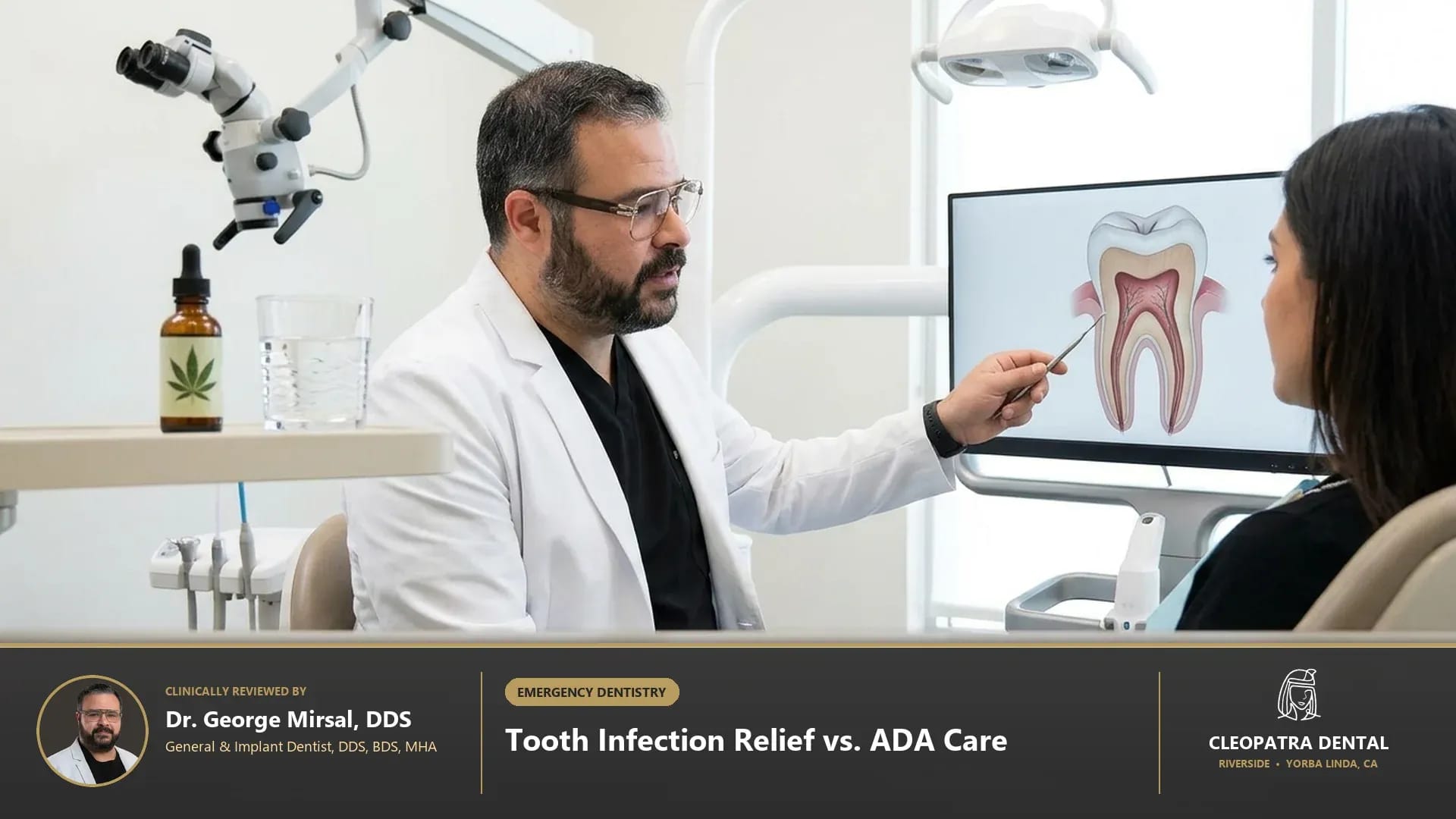
To understand why home remedies fail, one must examine the micro-anatomy of a human tooth. The exterior enamel and dentin form a rigid, mineralized vault protecting the inner dental pulp, which houses nerves and blood vessels. When deep dental decay or traumatic injury allows bacteria to enter the pulp chamber, the resulting inflammatory pressure cuts off blood flow through the microscopic apical foramen at the root tip. This produces pulpal necrosis—the tissue inside the tooth dies. Because there is no longer active microcirculation inside the tooth, neither swallowed herbs nor topical rinses can travel into the root canal system to eradicate bacterial colonies. When a fractured or decayed tooth is non-restorable, we provide gentle same-day surgical tooth extractions. When a fractured or decayed tooth is non-restorable, we provide gentle same-day surgical tooth extractions.
Clove Oil (Eugenol), Garlic, and Salt Water: What They Actually Do
Clove oil contains eugenol, an aromatic phenol with proven topical anesthetic properties that temporarily numbs exposed oral nerve fibers. Similarly, crushed raw garlic releases allicin, which exhibits transient surface antibacterial activity, and warm saltwater rinses draw fluid out of inflamed gingival tissues through osmotic pressure. However, these remedies only touch the surface of the gum tissue or tooth crown; they do not penetrate the sealed periapical bone where the abscess is actively expanding. Relying on home remedies allows microscopic bacteria to multiply unchecked beneath the jawbone. After definitive endodontic care, plan your recovery meals with our guide to the 50 best soft foods to eat after root canal treatment. After definitive endodontic care, plan your recovery meals with our guide to the 50 best soft foods to eat after root canal treatment.
CRITICAL MEDICAL WARNING: Life-Threatening Dental Infection Red Flags
A dental abscess is not merely an oral nuisance; it is an active infectious process situated inches from your airway, deep fascial spaces, and brain. If left untreated or masked with home remedies, odontogenic infections can spread rapidly through the submandibular, sublingual, and pharyngeal spaces, resulting in life-threatening complications. If you or a loved one exhibit any of the following emergency red flags, call 911 or report to the nearest hospital emergency room (such as Riverside Community Hospital or Kaiser Permanente Riverside Medical Center) immediately:
- Bilateral Submandibular Board-Like Swelling (Ludwig's Angina): Rapid, firm, woody swelling beneath both sides of the lower jaw and under the chin, accompanied by elevation and protrusion of the tongue.
- Dysphagia: Inability to swallow saliva, painful swallowing, or drooling due to throat constriction.
- Dyspnea: Shortness of breath, audible wheezing, or feeling like your throat is closing.
- Severe Trismus: Inability to open the mouth more than 20 millimeters (less than two fingers' width).
- Periorbital or Facial Cellulitis: Rapidly expanding swelling that closes the eye or extends down into the neck collarbone area.
- Systemic Signs of Sepsis: Fever equal to or exceeding 101°F (38.3°C), shaking chills, rapid heart rate, confusion, or extreme lethargy.
Recognizing Ludwig's Angina and Submandibular Space Infection
Ludwig's angina is a rapidly progressing, bilateral cellulitis of the sublingual and submandibular fascial spaces, typically originating from an infected lower second or third molar. As inflammatory exudate accumulates, the floor of the mouth elevates, pushing the tongue against the soft palate and completely occluding the airway within hours. This condition requires emergency hospital admission, intravenous antibiotic therapy, and often emergency surgical airway management via tracheostomy or fiberoptic intubation.
Airway Compromise and When to Go Directly to the ER or Call 911
A general dental office is designed for outpatient procedural care, not acute emergency airway management or intensive care resuscitation. If you experience difficulty breathing, high fever, or severe neck swelling, bypass the dental clinic and seek immediate emergency department care. For non-airway dental emergencies, our team provides urgent appointments in Riverside and Saturday emergency care in Yorba Linda. For weekend dental flare-ups, learn how to book our same-day and Saturday emergency dentist in Yorba Linda. For weekend dental flare-ups, learn how to book our same-day and Saturday emergency dentist in Yorba Linda.
ADA 2019 Antibiotic Stewardship: Why Operative Source Control Is Essential
In 2019, the American Dental Association (ADA) published landmark clinical practice guidelines regarding the use of systemic antibiotics for dental pain and swelling. The ADA expert panel concluded that for immunocompetent adult patients with localized pulpitis or symptomatic apical periodontitis, systemic antibiotics provide virtually zero pain relief and do not resolve the infection without physical operative intervention.
Physical Debridement vs. Chemical Suppression
Bacteria residing inside a necrotic root canal organize into complex biofilms protected by an extracellular polymeric matrix that is highly resistant to chemical suppression. The only biologically sound method to cure a dental infection is physical operative source control. This requires a dentist to mechanically debride, shape, disinfect, and hermetically seal the internal root canal system (endodontic therapy) or atraumatically extract the non-restorable tooth to drain periapical pus.
The Dangerous Myth of Curing Abscesses with Pills Alone
Many patients believe that taking leftover antibiotics from their medicine cabinet will "cure" their toothache. While a broad-spectrum antibiotic might temporarily diminish localized swelling by killing peripheral bacteria in surrounding soft tissues, the core reservoir inside the tooth remains fully colonized. As soon as the antibiotic course finishes, the infection rebounds aggressively—often with bacteria that have developed resistance to standard medications. When pericoronitis around third molars triggers swelling, consult our infected wisdom teeth removal guide. When pericoronitis around third molars triggers swelling, consult our infected wisdom teeth removal guide.
Clinical Comparison: Home Remedies vs. Professional Operative Care
Evaluating popular home remedies alongside definitive clinical procedures underscores the necessity of professional dental intervention.
| Treatment Approach | Biological Mechanism of Action | Depth of Antimicrobial Reach | Curative vs. Symptomatic Relief |
|---|---|---|---|
| Clove Oil (Eugenol) | Topical numbing of superficial mucosal nerve endings | Superficial oral mucosa and open coronal dentin only | Temporary palliative symptom relief (1 to 2 hours) |
| Warm Saltwater Rinses | Mild osmotic fluid reduction and mechanical debris clearance | Gingival sulcus and external oral epithelium | Symptomatic soothing; zero bacterial clearance inside bone |
| Crushed Garlic (Allicin) | Mild enzymatic disruption of bacterial cell walls | Direct topical contact zone; causes tissue chemical burns | Symptomatic only; risk of severe oral mucosal ulceration |
| Root Canal Therapy (D3310–D3330) | Mechanical extirpation, rotary shaping, and NaOCl disinfection | Complete micro-canal system to apical constriction | 100% Curative source control; preserves natural tooth |
| Surgical Extraction (D7140/D7210) | Complete removal of necrotic tooth and periapical curettage | Eliminates the entire bacterial reservoir immediately | 100% Curative source control; stops spread to fascial spaces |
The AHA 2021 Update: Why Clindamycin Is No Longer Recommended
Historically, clindamycin was frequently prescribed for dental infections in penicillin-allergic patients. However, the American Heart Association (AHA) 2021 guidelines officially removed clindamycin from all dental infective endocarditis prophylaxis protocols, and dental regulatory boards have followed suit. Clindamycin carries a disproportionately high risk of inducing fatal Clostridioides difficile (C. diff) pseudomembranous colitis, even after a single dose. First-line therapy for odontogenic infections requiring antibiotics remains Amoxicillin (500 mg every 8 hours), while true penicillin-allergic patients are safely treated with Azithromycin or Cephalexin under clinical guidance.
Evidence-Based Multimodal Analgesia: Alternating Ibuprofen and Acetaminophen
Patients frequently ask if they can take 600 mg of ibuprofen every 4 hours. Doing so exceeds the safe maximum daily threshold of 3,200 mg and risks severe gastric ulceration and acute kidney injury. Extensive clinical research published by the ADA confirms that the most potent non-opioid pain relief for acute dental infections is multimodal analgesia: alternating 400 to 600 mg of Ibuprofen (Advil/Motrin) with 500 mg of Acetaminophen (Tylenol) every 4 to 6 hours. This combination targets both peripheral inflammatory prostaglandins and central nervous system pain pathways simultaneously, providing superior pain control compared to opioid narcotics.
2026 Emergency Dental Infection Treatment Costs in Riverside & Yorba Linda
Emergency dental care requires immediate, transparent pricing so patients can seek professional treatment without fear of hidden expenses.
Important Pricing Note: The prices shown in the table below are estimated ranges; to obtain accurate pricing tailored to your specific clinical needs and insurance coverage, please contact our Riverside or Yorba Linda office.
| Emergency Procedure & ADA CDT Code | Estimated Cost Range | Emergency Insurance & Payment Options |
|---|---|---|
| Emergency Problem-Focused Oral Exam (D0140) | $85 – $175 | Covered at 80% to 100% under most PPO dental plans |
| Intraoral Diagnostic Periapical X-Ray (D0220) | $35 – $65 | Typically covered at 100% under standard diagnostic benefits |
| Incision and Drainage of Dental Abscess (D7510) | $250 – $550 | Covered under PPO major oral surgery benefits; CareCredit eligible |
| Emergency Pulpectomy / Palliative Relief (D9110) | $175 – $350 | Provides immediate pain relief by removing inflamed coronal pulp |
| Molar Root Canal Therapy (D3330) | $1,100 – $1,650 | Covered at 50% to 80% under PPO plans; monthly plans available |
| Simple / Surgical Tooth Extraction (D7140 / D7210) | $195 – $475 | Routine coverage under basic or major dental benefits |
Emergency Insurance Coverage and Co-Pay Rules
The vast majority of PPO dental insurance providers recognize acute dental infections as urgent care priorities, covering diagnostic exams (D0140) and digital X-rays (D0220) at minimal out-of-pocket expense. Emergency palliative care that relieves severe pain is routinely covered under basic services. For uninsured patients, Cleopatra Dental accepts CareCredit, Sunbit, and major credit cards to allow immediate treatment without delay.
Immediate Palliative Relief Options at Cleopatra Dental
If you cannot undergo definitive root canal therapy immediately, our dentists can perform an emergency pulpectomy (D9110) or incision and drainage (D7510) in under 30 minutes. By relieving intraosseous hydrostatic pressure and removing the infected nerve tissue, severe pain resolves almost instantly, stabilizing the tooth until a permanent crown or filling is placed.
Preventing Recurrent Infections: Long-Term Restorative Strategies
Resolving acute infection is merely the first phase of complete oral recovery. Preserving your restored tooth or planning tooth replacement ensures long-term chewing function and bone preservation. Walk-in and same-day emergency triage appointments are available at our Cleopatra Dental emergency clinic in Riverside. Walk-in and same-day emergency triage appointments are available at our Cleopatra Dental emergency clinic in Riverside.
Endodontic Therapy vs. Extraction and Future Replacement
Preserving your natural tooth through modern microscopic root canal therapy is always our clinical preference. Natural teeth maintain proprioceptive chewing sensation and prevent adjacent teeth from shifting. However, if a tooth has fractured below the alveolar bone crest or suffered massive structural destruction, atraumatic extraction followed by a dental implant represents the most predictable long-term restorative solution. Weekend and weekday urgent care is also available at our Yorba Linda emergency dental office. Weekend and weekday urgent care is also available at our Yorba Linda emergency dental office.
Joint Replacement Prophylaxis: Updated AAOS and ADA Guidelines
Patients with total knee or hip replacements frequently wonder if they require antibiotic prophylaxis prior to dental procedures. In according with updated guidelines jointly published by the American Academy of Orthopaedic Surgeons (AAOS) and the ADA, routine antibiotic premedication is no longer indicated for the vast majority of joint replacement patients. Prophylaxis is reserved exclusively for high-risk patients with previous prosthetic joint infections or severe systemic immunocompromise, as determined in consultation with your orthopedic surgeon.
Frequently Asked Questions About Tooth Infection Relief
Can natural remedies like clove oil or garlic cure a dental abscess?
No. While clove oil (eugenol) provides transient topical numbing and garlic contains mild antibacterial allicin, neither can penetrate the dead pulp chamber inside a tooth. Physical operative dental treatment by a dentist is biologically required to eliminate the infection.
Why did the ADA and AHA discontinue recommending clindamycin for dental infections?
Per AHA 2021 guidelines, clindamycin was removed from dental prophylaxis and treatment protocols due to high risks of severe, potentially fatal Clostridioides difficile colitis. Safer alternatives such as amoxicillin, cephalexin, or azithromycin are standard.
Can I safely take 600 mg of ibuprofen every 4 hours for severe tooth pain?
Taking 600 mg of ibuprofen every 4 hours exceeds the maximum recommended safe daily dose of 3,200 mg and risks severe gastrointestinal bleeding or kidney injury. The evidence-based dental protocol is alternating 400 to 600 mg of ibuprofen with 500 mg of acetaminophen every 4 to 6 hours.
What should I do if a tooth infection causes swelling under my jaw or difficulty breathing?
This is a life-threatening medical emergency signaling Ludwig's angina or spreading facial cellulitis. You must call 911 or go directly to the nearest hospital emergency room immediately; do not wait for a dental office appointment.
Verified Branch & Location: Visit Cleopatra Dental in Riverside at 2955 Van Buren Boulevard, Ste H4, Riverside, CA 92503 (serving Arlington, La Sierra, Canyon Crest, Wood Streets, Orangecrest, and Corona near Van Buren Blvd and CA-91), or view directions and verified patient reviews on Google Maps directions to our Riverside emergency clinic.
Clinically & Technically Reviewed By:
Dr. George Mirsal, DDS, BDS, MHA — General & Implant Dentist
Dr. Engy Halim, DDS, BDS — General & Cosmetic Dentist
Medical Disclaimer: This content is clinically reviewed for educational purposes in accordance with American Dental Association (ADA) and Dental Board of California guidelines and does not replace a direct in-person dental examination.