Porcelain Veneers in Riverside & Yorba Linda, CA: 2026 Smile Makeover
October 16, 2026
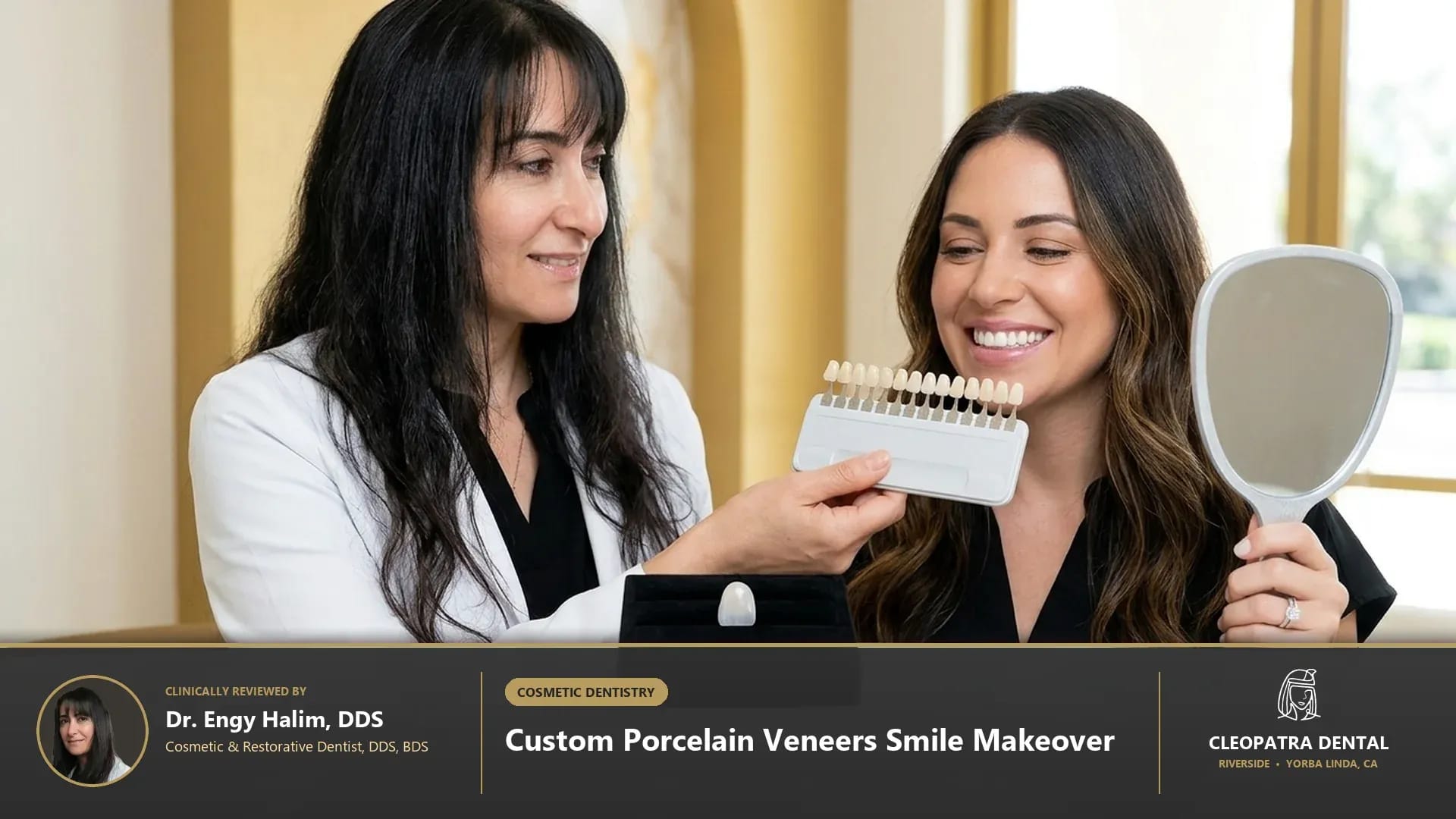
Quick Verified Summary: Porcelain veneers in Riverside and Yorba Linda transform discolored, chipped, or misaligned front teeth using ultra-thin, custom-crafted IPS e.max lithium disilicate ceramic shells. Requiring minimal 0.3 to 0.5 millimeter enamel reduction, veneers bond adhesively to natural enamel, offering exceptional stain resistance, natural light translucency, and fifteen to twenty years of clinical durability with proper nightguard care.
Understanding Porcelain Veneers and Modern Smile Design
A radiant, balanced smile influences personal confidence, social interactions, and professional opportunities. For patients in Southern California seeking to correct persistent intrinsic tooth discoloration, diastemas (gaps between teeth), chipped incisal edges, or slight cosmetic misalignments, custom porcelain veneers offer the gold standard in cosmetic restorative dentistry. Unlike composite bonding that can chip or stain over time, modern dental porcelain mimics the natural optical properties of human dental enamel with remarkable lifelike translucency and light reflection. At Cleopatra Dental, our general and cosmetic dental team provides comprehensive dental veneer consultations to evaluate your unique dental anatomy and aesthetic goals. Transform intrinsic discoloration, chips, and gaps with custom minimal-prep porcelain veneers crafted from IPS e.max ceramic. Transform intrinsic discoloration, chips, and gaps with custom minimal-prep porcelain veneers crafted from IPS e.max ceramic.
Porcelain veneers consist of microscopic ceramic facings individually designed to mask imperfections while reinforcing remaining natural tooth structure. By blending digital imaging, advanced biomaterials, and conservative tooth preparation, our clinicians deliver predictable, life-changing smile makeovers tailored to facial contours and patient preferences at our modern clinic in Riverside, CA and our convenient sister location in Yorba Linda, CA. Before any enamel preparation begins, patients test-drive their future smile using 3D Digital Smile Design (DSD) previews. Before any enamel preparation begins, patients test-drive their future smile using 3D Digital Smile Design (DSD) previews.
The Evolution of Lithium Disilicate Ceramics (IPS e.max)
Historically, traditional feldspathic porcelain restorations were prone to edge chipping under high masticatory load. Contemporary cosmetic dental practices utilize high-strength lithium disilicate ceramic (such as IPS e.max), which provides flexural strength between 400 and 500 MPa—nearly four times stronger than legacy dental porcelains. This glass-ceramic material features needle-like lithium disilicate crystals embedded in a glassy matrix, dispersing mechanical stress and providing superior resistance against fracture. Furthermore, its refractive index closely parallels natural hydroxyapatite crystals, creating an authentic depth of shade that avoids the opaque, chalky appearance associated with low-cost restorative materials. For conservative posterior tooth restoration, explore our guide on biomimetic porcelain inlays and onlays vs. full crowns. For conservative posterior tooth restoration, explore our guide on biomimetic porcelain inlays and onlays vs. full crowns.
Biological Enamel Conservation: The 0.3 to 0.5 mm Standard
Preserving natural tooth biology is the cornerstone of responsible cosmetic dentistry. Modern porcelain veneers are engineered as minimal-prep restorations, demanding merely 0.3 to 0.5 millimeters of facial enamel reduction. Confining tooth preparation strictly within the outer enamel envelope is crucial: adhesive bond strength between resin cement and etched enamel exceeds 30 MPa, whereas bonding to deeper dentin yields significantly lower bond durability over time. Transparent clinical disclosure is essential—this minimal enamel reduction is irreversible, making lifelong commitment to porcelain or composite coverage necessary once teeth are prepared.
The Digital Smile Design (DSD) Workflow at Cleopatra Dental
Achieving predictable cosmetic success requires eliminating subjectivity before touching a dental handpiece. Through our integrated Digital Smile Design protocol, patients actively co-design their future smile alongside our experienced dental clinicians.
Diagnostic 3D Intraoral Scanning and Facial Esthetic Analysis
The cosmetic transformation begins with high-resolution digital optical impressions and standardized dental photography capturing resting lip lines, dynamic high-smile lip postures, and interpupillary horizontal reference lines. This digital data is imported into specialized CAD/CAM software to analyze the golden proportion (the mathematical ratio of visible anterior tooth widths), incisal plane parallelism, and gingival contour symmetry. We evaluate phonetic parameters—verifying that incisal edges lightly touch the wet-dry border of the lower lip during "F" and "V" sound enunciations—to ensure functional harmony alongside aesthetic perfection. Patients with deep bites or occlusal wear should read our clinical analysis on whether porcelain veneers can correct an overbite. Patients with deep bites or occlusal wear should read our clinical analysis on whether porcelain veneers can correct an overbite.
The Diagnostic Mockup: Test-Driving Your Smile Before Preparation
Before any tooth preparation occurs, our dental laboratory fabricates a physical 3D diagnostic wax-up based on the approved digital smile design. During your preparation visit, we transfer this design directly to your mouth using a bis-acryl temporary resin matrix. This diagnostic mockup allows you to evaluate tooth length, contour, phonetics, and facial balance in real time in a mirror. Any aesthetic modifications can be communicated and adjusted immediately, ensuring that your definitive porcelain veneers match your exact vision.
Clinical Comparison: Porcelain Veneers vs. Composite Bonding vs. Full Crowns
Selecting the ideal restorative pathway involves weighing longevity, enamel preservation, aesthetic demands, and financial investment. Patients often compare porcelain veneers with direct resin bonding or full-coverage restorations when planning cosmetic enhancements.
| Restorative Parameter | IPS e.max Porcelain Veneers | Direct Composite Bonding | Full-Coverage Porcelain Crowns |
|---|---|---|---|
| Primary Indication | Comprehensive smile makeover, deep intrinsic stains, minor crowding | Isolated small chips, minor diastemas, single-tooth cosmetic touches | Extensively decayed, cracked, or root-canal-treated teeth |
| Enamel Preparation Depth | 0.3 mm – 0.5 mm facial enamel only | 0.0 mm – 0.2 mm (often zero preparation) | 1.5 mm – 2.0 mm circumferential 360-degree reduction |
| Material Composition | Milled lithium disilicate glass-ceramic | Direct micro-hybrid or nano-filled resin | Monolithic zirconia or lithium disilicate |
| Stain & Wear Resistance | Impervious to coffee, tea, wine, and smoke | Prone to surface discoloration and dulling over time | Impervious to extrinsic staining |
| Expected Service Life | 15 to 20+ years with proper maintenance | 4 to 7 years before repolishing or replacement | 15 to 25+ years with healthy periodontal support |
Material Longevity and Optical Properties
While composite bonding offers an economical and fast same-day solution, direct composite resins exhibit organic polymer matrices that gradually absorb pigments from food and beverages, leading to marginal discoloration within several years. In contrast, glazed ceramic veneers resist extrinsic staining permanently and maintain their high-gloss finish. For patients dealing with bite alignment concerns, understanding the interplay between tooth alignment and cosmetic restorations is critical; our detailed analysis explains whether porcelain veneers can fix an overbite or if orthodontic realignment is required first. To brighten adjacent natural teeth prior to shade matching, compare in-office teeth whitening vs. custom take-home trays. To brighten adjacent natural teeth prior to shade matching, compare in-office teeth whitening vs. custom take-home trays.
Structural Invasiveness and Pulp Health Preservation
Traditional full crowns require removing 60% to 75% of coronal tooth structure, placing mechanical and thermal stress on the dental pulp that occasionally precipitates pulpitis and requires endodontic therapy. Porcelain veneers represent a conservative biomimetic alternative, preserving the underlying dentin core, maintaining tooth structural stiffness, and minimizing risk to pulpal vitality.
2026 Porcelain Veneers Cost and Financing in Riverside and Yorba Linda
Understanding the financial parameters of cosmetic dental care empowers patients to make well-informed decisions. Porcelain veneer pricing varies based on the number of units treated, aesthetic complexity, laboratory ceramist expertise, and the necessity of adjunctive gum recontouring.
Important Pricing Note: The prices shown in the table below are estimated ranges; to obtain accurate pricing tailored to your specific clinical needs and insurance coverage, please contact our Riverside or Yorba Linda office.
| Cosmetic Procedure & ADA CDT Code | Estimated Cost Range (Per Tooth / Unit) | Insurance & Financing Guidelines |
|---|---|---|
| Labial Porcelain Veneer - Ceramic (D2962) | $1,250 – $2,400 | Elective cosmetic; covered under select PPO plans if repairing trauma |
| Direct Composite Resin Veneer (D2960) | $400 – $850 | Lower initial investment; financing available via CareCredit |
| Digital Smile Design & 3D Wax-Up (D0470 / D0350) | $350 – $750 | Often applied toward full treatment package upon case acceptance |
| Custom Occlusal Nightguard (D9944) | $450 – $800 | Frequently covered (50%-80%) under dental PPO major benefits |
| Full Smile Makeover (6 to 8 Anterior Veneers) | $7,500 – $18,000 | Monthly financing plans starting around $199/month through LendingClub |
Dental Insurance and PPO Benefit Optimization
Because porcelain veneers are generally classified as elective aesthetic treatments, standard dental insurance policies rarely provide direct coverage. However, our experienced administrative coordinators review your PPO policy details to maximize applicable benefits for diagnostic imaging, pre-restorative periodontal cleanings, or restorative crown conversions when structural decay is present.
Flexible Healthcare Financing and Payment Arrangements
To ensure high-quality cosmetic care remains accessible, Cleopatra Dental partners with reputable third-party healthcare lenders including CareCredit, Proceed Finance, and LendingClub. These programs offer zero-interest promotional terms for 6 to 24 months as well as extended payment schedules up to 60 months, allowing you to achieve your dream smile with comfortable, predictable monthly payments.
Step-by-Step Procedure: What to Expect During Treatment
Completing a custom porcelain veneer makeover at Cleopatra Dental typically spans two to three comfortable clinical visits over a two-to-three-week timeframe.
Appointment 1: Comprehensive Consultation and Smile Blueprint
During your initial consultation, we perform an exhaustive dental examination, evaluate periodontal health, capture digital radiographs, and record 3D intraoral optical scans. We discuss tooth shape preferences, smile width, and shade objectives, formulating a tailored treatment proposal and initiating the digital smile design wax-up.
Appointment 2: Micro-Preparation and Custom Provisionals
Under gentle local anesthesia, the cosmetic clinician conservatively shapes the facial enamel by 0.3 to 0.5 mm, establishing smooth margins at or slightly above the gumline. A definitive digital scan is captured and electronically transferred to our master dental laboratory. Custom temporary veneers fabricated from your diagnostic mockup are securely placed, protecting your teeth and allowing you to preview your new smile aesthetics in daily life.
Appointment 3: Adhesive Bonding and Final Curing
Approximately two weeks later, the provisional restorations are gently removed, and each natural tooth is cleaned and isolated. The master ceramist's custom veneers are individually evaluated for fit, contact tightness, and shade harmony. After etching the tooth enamel with 37% phosphoric acid and treating the inner ceramic surface with silane coupling agent, a light-cured resin cement is applied. High-intensity LED curing lights polymerize the resin, forming an exceptionally durable, permanent bond.
Post-Placement Veneer Care and Nocturnal Bruxism Protection
With conscientious oral care, porcelain veneers provide decades of radiant function. Protecting your ceramic investment requires understanding basic maintenance rules and defending against mechanical stress. Schedule your custom ceramic veneer mockup at our Riverside cosmetic dentistry studio. Schedule your custom ceramic veneer mockup at our Riverside cosmetic dentistry studio.
The Essential Role of Custom Occlusal Nightguards (CDT D9944)
Nocturnal bruxism (involuntary clenching and grinding during sleep) can generate forces exceeding 250 pounds per square inch. While lithium disilicate is exceptionally strong against axial chewing loads, lateral shearing forces can induce microfractures or debonding at the incisal edges. Fabricating a custom-milled hard acrylic occlusal nightguard under CDT code D9944 creates a protective barrier, redistributing bite forces and ensuring the structural integrity of your veneers for decades. Orange County patients can also experience Digital Smile Design at Cleopatra Dental in Yorba Linda, CA. Orange County patients can also experience Digital Smile Design at Cleopatra Dental in Yorba Linda, CA.
Daily Hygiene and Professional Maintenance Protocols
Maintain your veneers by brushing twice daily with a non-abrasive fluoride toothpaste and flossing carefully around the margins. Avoid chewing ice, biting hard candies, using teeth as tools, or biting directly into excessively hard foods. Schedule routine dental hygiene visits every six months at our Riverside or Yorba Linda office for professional examinations, gentle ultrasonic scaling, and specialized polishing that preserves the high-gloss ceramic glaze.
Frequently Asked Questions About Porcelain Veneers in Riverside
How long do porcelain veneers last on front teeth?
Clinical longevity studies demonstrate that high-grade IPS e.max porcelain veneers maintain a success rate exceeding 93% at fifteen to twenty years. Maximizing their lifespan requires diligent daily oral hygiene, avoiding non-food biting habits, and wearing a custom occlusal nightguard to cushion ceramic surfaces against nocturnal bruxism forces.
Does getting porcelain veneers ruin your natural teeth?
No. Modern minimal-prep veneer techniques involve removing only a microscopic 0.3 to 0.5 millimeter layer of facial enamel, which is comparable to the thickness of a contact lens. By confining reduction within the enamel substrate, the tooth's structural core, internal dentin, and pulp vitality remain completely healthy and protected.
Can porcelain veneers stain or discolor from coffee or wine?
High-density lithium disilicate porcelain is completely non-porous and impervious to extrinsic staining agents such as coffee, tea, red wine, and tobacco. While the glazed porcelain surface will never darken, maintaining clean margins through routine professional cleanings prevents staining on adjacent natural tooth enamel.
Are porcelain veneers covered by dental insurance in California?
Because porcelain veneers are primarily categorized as elective cosmetic procedures, traditional dental insurance policies typically do not cover their cost. However, if veneers are placed to restore teeth fractured by trauma or severely weakened by congenital enamel hypoplasia, partial restorative benefits may apply. Flexible financing is available through CareCredit and Proceed Finance.
Verified Branch & Location: Visit Cleopatra Dental in Riverside at 2955 Van Buren Boulevard, Ste H4, Riverside, CA 92503 (serving Arlington, La Sierra, Canyon Crest, Wood Streets, Orangecrest, and Corona near Van Buren Blvd and CA-91), or view directions and verified patient reviews on Cleopatra Dental Riverside cosmetic studio on Google Maps.
Clinically & Technically Reviewed By:
Dr. Engy Halim, DDS, BDS — General & Cosmetic Dentist
Dr. George Mirsal, DDS, BDS, MHA — General & Implant Dentist
Medical Disclaimer: This content is clinically reviewed for educational purposes in accordance with American Dental Association (ADA) and Dental Board of California guidelines and does not replace a direct in-person dental examination.