Main Types of Dental Implants: Endosteal, Subperiosteal & Zirconia
October 29, 2026
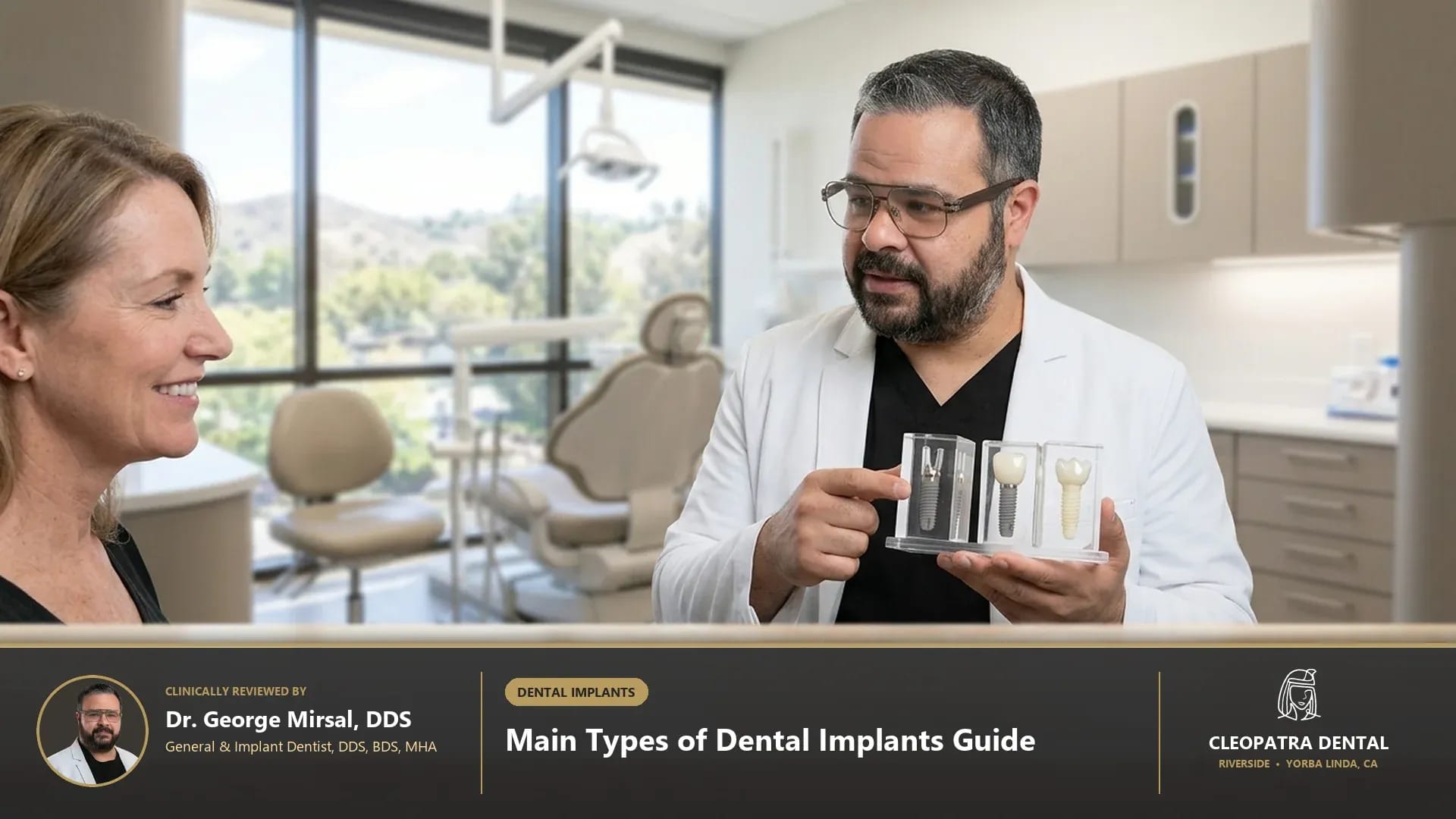
Quick Verified Summary: The main types of dental implants used in modern restorative dentistry include endosteal root-form fixtures (95% of cases), subperiosteal custom frameworks, and full-arch multi-unit systems crafted from FDA 510(k)-cleared Grade 4/5 titanium or metal-free yttria-stabilized zirconia. Selecting the ideal implant depends on 3D CBCT alveolar bone height, soft-tissue biotype, and occlusal load requirements.
Clinical Foundations: Understanding Main Types of Dental Implants: Endosteal, Subperiosteal & Zirconia
Patients researching main types of dental implants in Southern California deserve transparent, evidence-based guidance rooted in biological tooth preservation and long-term oral systemic health. At Cleopatra Dental, our general, restorative, and surgical clinicians evaluate every patient as a complete biomechanical system rather than treating isolated symptoms. In daily practice across Western Riverside County and North Orange County, we find that voxel-calibrated 3D CBCT imaging (CDT D0367) measures residual alveolar ridge width (minimum 6.0 mm required for standard 4.0 mm diameter fixtures to maintain 1.5 mm buccal/lingual bone walls) and vertical clearance from the maxillary sinus and mandibular canal. This diagnostic precision prevents guesswork, minimizes chairside discomfort, and establishes predictable clinical outcomes for families and older adults alike. Restore chewing power and preserve jawbone volume with custom titanium and zirconia dental implants engineered for long-term stability.
Modern dentistry has evolved rapidly away from aggressive mechanical preparation toward minimally invasive, biologically guided care. When evaluating endosteal vs subperiosteal implants, our diagnostic team examines how enamel thickness, underlying dentin tubules, periodontal ligament fibers, and occlusal biting forces interact over a 10- to 20-year horizon. By integrating digital optical scanning, low-dose imaging, and biocompatible materials coded under ADA CDT standards (D6010, D6013, D6058, D6114), we tailor each treatment plan to your specific anatomy, medical history, and comfort preferences. Patients missing most or all teeth in an arch can also compare single fixtures against All-on-X full-arch implant bridges.
Biological & Biomechanical Principles Behind endosteal vs subperiosteal implants
Every clinical decision in restorative and preventive dentistry depends on respecting microscopic tissue thresholds. Scientific studies confirm that two-piece bone-level titanium implants allow submerged osseointegration and 15-to-30-degree angled screw-channel correction at 35 Ncm torque, whereas one-piece ceramic zirconia implants eliminate the micro-gap at the crestal bone interface. When these quantitative parameters are carefully controlled at the chairside, natural dental tissues and prosthetic restorations withstand daily mastication forces—which routinely reach 70 to 150 pounds per square inch during normal chewing and exceed 250 pounds per square inch during nocturnal clenching—without premature wear, sensitivity, or structural fatigue. Once you select your fixture design, review our complete dental implant surgery preparation and recovery guide.
Advanced Biomaterials and Digital Diagnostic Standards
Material science plays an equally decisive role in clinical longevity and biocompatibility. In our clinical protocols, we utilize FDA 510(k)-cleared Class II endosteal implants (CDT D6010) in commercially pure Grade 4 titanium, Ti-6Al-4V ELI alloy (tensile strength > 860 MPa), and metal-free yttria-stabilized tetragonal zirconia polycrystal (Y-TZP, flexural strength 900–1,200 MPa), alongside mini implants (D6013, 1.8–2.9 mm diameter). Unlike legacy dental materials that relied on mechanical wedging or high-expansion metals, contemporary ceramic, polymer, and biologic systems bond adhesively or integrate directly with host tissues. This seals out cariogenic oral bacteria, maintains neutral salivary pH balance, and delivers natural optical translucency that blends seamlessly with your surrounding smile. When thin alveolar ridges require biological augmentation before endosteal placement, read our guide on step-by-step PRF membrane grafting for implant bone support.
Side-by-Side Clinical Comparison & Candidacy Matrix
Choosing the right clinical pathway requires comparing treatment modalities across biological conservation, expected service life, patient comfort, and maintenance requirements. During your consultation, our doctors review high-resolution intraoral photographs with you on a chairside monitor so you can see exactly what we see. The clinical comparison matrix below summarizes how each diagnostic and therapeutic option performs in real-world practice. If you are deciding between an endosteal implant and a tooth-supported bridge, read how long a fixed dental bridge lasts compared to an implant.
| Implant Classification | Anatomical Placement & Geometry | Biomaterial & FDA 510(k) Class | Primary Clinical Indication & 10-Year Survival |
|---|---|---|---|
| Two-Piece Endosteal Titanium (D6010) | Placed directly inside alveolar cortical/trabecular bone; 3.3–5.5 mm diameter | Grade 4 CP Titanium or Grade 5 Ti-6Al-4V SLA surface (Class II 510(k)-cleared) | Gold standard for single crowns, bridges, and All-on-4 arches; 97%–98.5% survival |
| One- or Two-Piece Zirconia Ceramic (D6010) | Endosteal root-form placement; ivory tooth-colored monoblock or bonded abutment | Yttria-stabilized tetragonal zirconia polycrystal (Y-TZP, metal-free) | Patients with verified titanium hypersensitivity or thin anterior gingival biotype; 94%–96% survival |
| Narrow-Diameter / Mini Implants (D6013) | Transgingival one-piece screw; 1.8–2.9 mm narrow diameter with ball/O-ring head | Ti-6Al-4V titanium alloy requiring minimal osteotomy width (< 4.5 mm ridge) | Stabilizing lower removable overdentures or narrow lateral incisor spaces; 91%–94% survival |
| Custom Subperiosteal Implants (D6040) | Rests on top of cortical jawbone beneath the mucoperiosteal gum tissue | 3D direct metal laser-sintered (DMLS) custom titanium sub-frame | Severe bone atrophy when patients cannot undergo bone grafting or sinus lifts; 88%–92% survival |
| Angled Multi-Unit Full-Arch Systems (D6114) | 4 to 6 endosteal fixtures with posterior implants tilted 30–45 degrees | High-torque tapered titanium fixtures with multi-unit prosthetic abutments | Immediate-load edentulous full-arch rehabilitation avoiding sinus grafting; 97%+ survival |
How We Customize Candidacy for Complex Medical Histories
No two mouths age or heal identically. Patients managing systemic conditions such as Type 2 diabetes, hypertension, autoimmune disorders, osteoporosis, or medication-induced dry mouth (xerostomia) require customized dental protocols. Before initiating treatment related to zirconia vs titanium dental implants, we review your current medications, allergies, and systemic health markers. Adjusting local anesthetic buffering, selecting hypoallergenic metal-free ceramics, and reinforcing salivary mineral buffering ensures safe, predictable healing for every age group.
Preventing Common Complications and Premature Failure
Even the finest dental restoration or preventive regimen requires protection against mechanical overload and bacterial biofilm accumulation. In clinical audits, the two leading causes of preventable dental breakdown are unaddressed nighttime teeth grinding (sleep bruxism) and interproximal plaque stagnation along the gumline. Addressing occlusal harmony early and establishing an easy-to-follow home care routine protects both your natural enamel and any restorative work for decades.
Long-Term Maintenance & Preventive Follow-Up in Southern California
Sustaining healthy clinical results over 10 to 20 years depends on partnering with a consistent dental team that monitors your gum attachment levels, bite balance, and restorative margins at every six-month checkup. At our Riverside and Yorba Linda locations, we combine ultrasonic hygiene care, digital bitewing monitoring, and occlusal nightguard checks to catch micro-changes long before they become costly emergencies.
2026 Cost Guide, ADA CDT Codes & PPO Insurance in Riverside and Yorba Linda
Financial clarity is a core pillar of patient trust at Cleopatra Dental. Treatment fees in Southern California vary according to diagnostic complexity, the number of teeth or quadrants involved, laboratory biomaterial selection, and your dental PPO insurance benefits. Before any procedure begins, our treatment coordinators verify your insurance eligibility and provide a clear, written breakdown organized by official American Dental Association Current Dental Terminology (CDT) codes.
Important Pricing Note: The prices shown in the table below are estimated ranges; to obtain accurate pricing tailored to your specific clinical needs and insurance coverage, please contact our Riverside or Yorba Linda office.
| Implant System & ADA CDT Code | Estimated Cost & Price Range (2026) | Prosthetic Pairing & Coverage Guidelines |
|---|---|---|
| Standard Endosteal Titanium Implant Fixture (D6010) | $1,850 – $2,950 | Includes surgical placement and healing cap; compatible with custom titanium/zirconia abutments |
| Metal-Free Ceramic Zirconia Implant Fixture (D6010) | $2,300 – $3,400 | Hypoallergenic ivory-shaded Y-TZP ceramic; ideal for high-smile-line anterior aesthetics |
| Mini / Narrow-Diameter Implant for Overdenture (D6013) | $950 – $1,550 | Per fixture (typically 4 placed in anterior mandible for snap-on denture retention) |
| Implant-Supported Porcelain/Zirconia Crown & Abutment (D6057 + D6058) | $2,100 – $3,350 | Definitive CAD/CAM abutment and screw-retained monolithic zirconia crown |
| Two-Implant Mandibular Overdenture Package (D6010 x2 + D6111) | $6,800 – $10,500 | Complete removable snap-on lower prosthesis with Locator attachments; 0% financing available |
Maximizing Dental PPO Insurance, HSA/FSA Funds & 0% Financing
Most PPO dental insurance plans categorize diagnostic exams, digital X-rays, and routine cleanings under preventive benefits covered at 80% to 100%, while basic and major restorative procedures receive 50% to 80% coverage up to your annual plan maximum (typically $1,500 to $2,500 per calendar year). For treatments that exceed annual insurance caps or involve elective cosmetic enhancements, patients can apply tax-free Health Savings Account (HSA) or Flexible Spending Account (FSA) dollars, or enroll in 0% APR promotional monthly financing through CareCredit, LendingClub, and Proceed Finance.
Step-by-Step Clinical Protocol & Long-Term Care Guidelines
Knowing exactly what happens before, during, and after your visit eliminates dental anxiety and empowers you to participate actively in your oral health. Our clinical workflow enforces matching fixture macro-geometry (tapered aggressive threads for soft Misch Type III/IV maxillary bone vs. parallel-walled threads for dense Type I/II mandibular bone) achieves ISQ >= 70 and 96% to 98% ten-year survival rates. By breaking complex care into calm, well-paced stages, we ensure your comfort from initial check-in through long-term maintenance. Comprehensive 3D CBCT implant candidacy consultations are offered Monday through Saturday at our Yorba Linda implant dentistry studio.
Step 1: Comprehensive Digital Assessment and Shade/Bite Mapping
Your appointment begins with a conversation about your goals, symptoms, and past dental experiences, followed by gentle digital diagnostics. Using radiation-free iTero 3D optical scanning, intraoral high-definition cameras, and ultra-low-dose digital radiographs when indicated, we map your teeth, gums, and bite registration within minutes—eliminating messy impression trays and providing an immediate 3D visual roadmap of your mouth. Inland Empire patients can access identical endosteal and full-arch implant workflows at our Riverside surgical dental office.
Step 2: Precision Chairside Execution and Post-Care Verification
During active care, we prioritize profound comfort using topical numbing gels, pH-buffered local anesthetics, and optional nitrous oxide or oral conscious sedation. Every margin, contact point, and biting surface is verified under high magnification before you leave the chair. You also receive written post-visit care instructions and a direct follow-up call from our clinical team to confirm your recovery is progressing smoothly.
Frequently Asked Questions About Main Types of Dental Implants: Endosteal, Subperiosteal & Zirconia
Are titanium and zirconia dental implants FDA-approved or FDA-cleared?
Under U.S. Food and Drug Administration regulations (21 CFR § 807.97), endosteal titanium and zirconia dental implants are regulated as Class II medical devices that receive FDA 510(k) clearance based on biocompatibility and mechanical testing. Both materials demonstrate exceptional osseointegration when placed using 3D CBCT surgical guidance.
Which is better for front teeth: titanium or ceramic zirconia implants?
For patients with a thin, translucent gum biotype (less than 1.5 mm thick), either a zirconia ceramic implant or a titanium implant paired with a custom white zirconia abutment (CDT D6057) prevents any grayish metallic shadow from showing through the gumline.
Why are subperiosteal implants rarely used compared to endosteal implants today?
Because modern guided bone regeneration, sinus floor elevation, and Leukocyte-Platelet-Rich Fibrin (L-PRF) grafting allow clinicians to rebuild deficient jawbone predictably, root-form endosteal implants placed inside living bone achieve much higher long-term survival (97%+) than subperiosteal frames resting on top of the bone.
Can mini dental implants support a permanent molar crown?
Mini dental implants (CDT D6013, under 3.0 mm in diameter) have significantly less surface area and lower fatigue fracture resistance under heavy posterior chewing forces (which exceed 150 to 250 psi). They are best reserved for stabilizing removable lower dentures or replacing tiny lower incisors rather than single molars.
Verified Branch & Location: Visit Cleopatra Dental in Yorba Linda at 18651 Yorba Linda Blvd, Yorba Linda, CA 92886 (serving East Lake Village, Travis Ranch, Bryant Ranch, Kerrigan Ranch, Anaheim Hills, and Placentia near Yorba Linda Blvd and Imperial Hwy), or view directions and verified patient reviews on Cleopatra Dental Yorba Linda dental implant center on Google Maps.
Clinically & Technically Reviewed By:
Dr. George Mirsal, DDS, BDS, MHA — General & Implant Dentist
Dr. Engy Halim, DDS, BDS — General & Cosmetic Dentist
Medical Disclaimer: This content is clinically reviewed for educational purposes in accordance with American Dental Association (ADA) and Dental Board of California guidelines and does not replace a direct in-person dental examination.