Dental implants are one of the most sophisticated methods of dental restoration, providing not only visual improvements but also enhanced comfort, jawbone support, and improved chewing ability compared to other types of restoration. In this article, we address the question: What is the procedure for getting a dental implant?Quick Verified Clinical Summary (2026): At Cleopatra Dental in Riverside (92503) and Yorba Linda (92886), our evidence-based protocols for 3D CBCT-guided dental implants (CDT D6010) combine low-dose 3D CBCT imaging, intraoral optical scanning, and FDA-cleared (510(k)) biocompatible materials to protect long-term oral health. All treatments are performed by Dr. George Mirsal, DDS (CA Lic. #104686) and Dr. Engy Halim, DDS (CA Lic. #108001), California licensed general dentists.
What Is the Procedure for Getting a Dental Implant?
There are several steps in the dental implant procedure:Preparation for the Procedure
If you decide to get a dental implant, the first step is a consultation with an oral surgeon. This specialist will assess the condition of your oral health and consider your overall health to determine if you are a suitable candidate for the procedure. Several factors are considered before the decision is made:- The jaw bone has enough density to support the implant (jawbone density loss can occur due to gum disease or the process called bone resorption in cases when you have been missing your natural teeth for a long time)
- There is no active gum infection (gum disease)—it will have to be treated and the gum tissue restored before implant placement.
- There are no general health conditions that can hinder post-surgery healing and regeneration (for example, immunity deficiency, some types of cancer, uncontrolled diabetes)
- Dental imaging (panoramic X-ray, Cone Beam CT (CBCT) scan, periapical X-rays) to view the anatomy of your jaw, teeth, sinuses, and nerves, measure bone height, width, and density, and determine implant placement angles.
- Bite analysis to check how your upper and lower teeth fit together and plan implant positioning so the bite remains comfortable and functional.
- Study models or digital scans to create a 3D model of your teeth and bite, allowing for the design of an implant restoration with the exact size and shape.
- Blood tests and a review of general health history.
>Similarly, grafts can be used to stimulate gum regeneration (gum grafting) in cases where the gum is weakened by gum disease.
Implant Placement
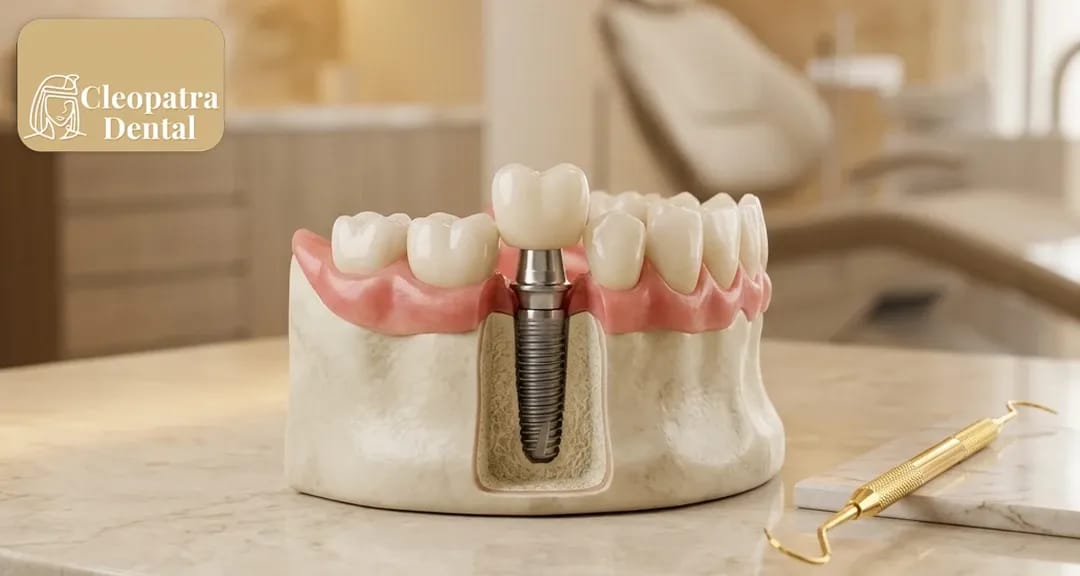
Once all the preparations are completed and your doctor has prepared your implants, the surgery itself is scheduled. Dental implant surgery is typically performed under local anesthesia. This numbs the surgical area and prevents the patient from experiencing pain or discomfort during the procedure. In some cases, sedation can be used in addition to the local anesthetic. At the beginning of the surgery, your doctor will make a small incision in the gum. This exposes the underlying jawbone where the implant will be placed. Then, using a dental drill, the surgeon creates a precisely measured hole in the jawbone, The hole size matches the planned implant dimensions, ensuring its stability. Then, the titanium implant post is screwed or tapped into the prepared hole. This post will fuse with the jawbone over time and will act like the roots of a natural tooth. Once the post is securely placed within the bone, a healing cap (abutment) or a cover screw is placed on top of the implant. This protects it during the healing period. The gum tissue is repositioned and stitched around the healing cap. In some cases, this is over the cover screw as the last step of the procedure. In some cases, a dental crown can be placed on the same day; however, it is more often placed after the post has securely healed.Get High-Quality Dental Implants at Dentistry Yorba Linda
Do not hesitate to make an appointment with an experienced dentist at Dentistry Yorba Linda today. We provide our patients with high-quality and reliable dental implants. We are looking forward to your visit.Learn more about our Dental Implants services at Cleopatra Dental in Riverside & Yorba Linda, CA.
2026 Clinical Standards, ADA CDT Coding & Patient Care in Riverside & Yorba Linda, CA
Understanding the clinical evidence behind What Is the Procedure for Getting a Dental Implant? empowers patients across the Inland Empire and North Orange County to make informed, preventative decisions before minor symptoms escalate into complex dental emergencies. At Cleopatra Dental — Riverside (2955 Van Buren Blvd, Ste H4, Riverside, CA 92503 | (951) 689-8544) and Cleopatra Dental — Yorba Linda (18651 Yorba Linda Blvd, Yorba Linda, CA 92886 | (714) 777-5541), our clinical team utilizes high-resolution 3D CBCT imaging, digital optical impressions, and FDA-cleared (510(k)) materials across all 3D CBCT-guided dental implants protocols (Endosteal Implant Placement (CDT D6010), Custom Abutment (CDT D6057), Zirconia Implant Crown (CDT D6058), Full-Arch Fixed Prosthesis (CDT D6114/D6115), Socket Bone Graft (CDT D7953)).
2026 ADA CDT Procedure Codes & Clinical Longevity Reference
| ADA CDT Code | Clinical Procedure Description | Expected Clinical Longevity / Outcome | Diagnostic & Care Standard |
|---|---|---|---|
| D6010 | Surgical Placement of Endosteal Implant Body (Titanium / Zirconia) | 15 to 25+ Years (95%–98% Survival) | 3D CBCT Nerve & Bone Density Mapping |
| D6057 / D6058 | Custom Abutment & Abutment-Supported Porcelain/Zirconia Crown | 10 to 15+ Years | Digital Intraoral CAD/CAM Scan |
| D6114 / D6115 | All-On-X Full-Arch Fixed Hybrid Prosthesis (Maxillary / Mandibular) | 15 to 25+ Years (Fixtures) | 4–6 Angled Implants + Multi-Unit Abutments |
| D7953 | Bone Replacement Graft for Ridge Preservation (Socket Graft) | Permanent Alveolar Ridge Support | Placed Immediately at Extraction |
What to Expect During Your Evaluation & PPO Insurance Coverage
- Comprehensive Digital Diagnostics (CDT D0150 / D0140): Every visit begins with a gentle clinical evaluation, periodontal probing, and ultra-low-dose digital X-rays or 3D CBCT scanning so you can see your exact dental anatomy on screen.
- Transparent PPO Insurance & Flexible Financing: We accept most major PPO dental insurance plans—including Delta Dental, Cigna, MetLife, Aetna, Guardian, and Humana—and offer our in-house Cleopatra Dental VIP Membership Plan alongside 0% APR financing options via CareCredit and Sunbit (please note we do not accept Medi-Cal or Denti-Cal).
- Convenient Scheduling Across Two Southern California Locations: Whether you commute along the 91 corridor in Riverside (Mon–Thu 9:00 AM – 5:30 PM) or Yorba Linda (Mon–Thu 9:00 AM – 5:00 PM; alternate Saturdays 8:00 AM – 2:00 PM by appointment), our bilingual team coordinates seamless care.
California Dental Board Regulatory Disclosure (CA B&P Code § 651): All general, cosmetic, restorative, endodontic, periodontal, orthodontic, and implant procedures at Cleopatra Dental are performed by Dr. George Mirsal, DDS (CA Lic. #104686) and Dr. Engy Halim, DDS (CA Lic. #108001). Services provided by a California licensed general dentist.