What to Avoid After Fluoride Treatment: Hour-by-Hour Eating & Care Guide
October 22, 2026
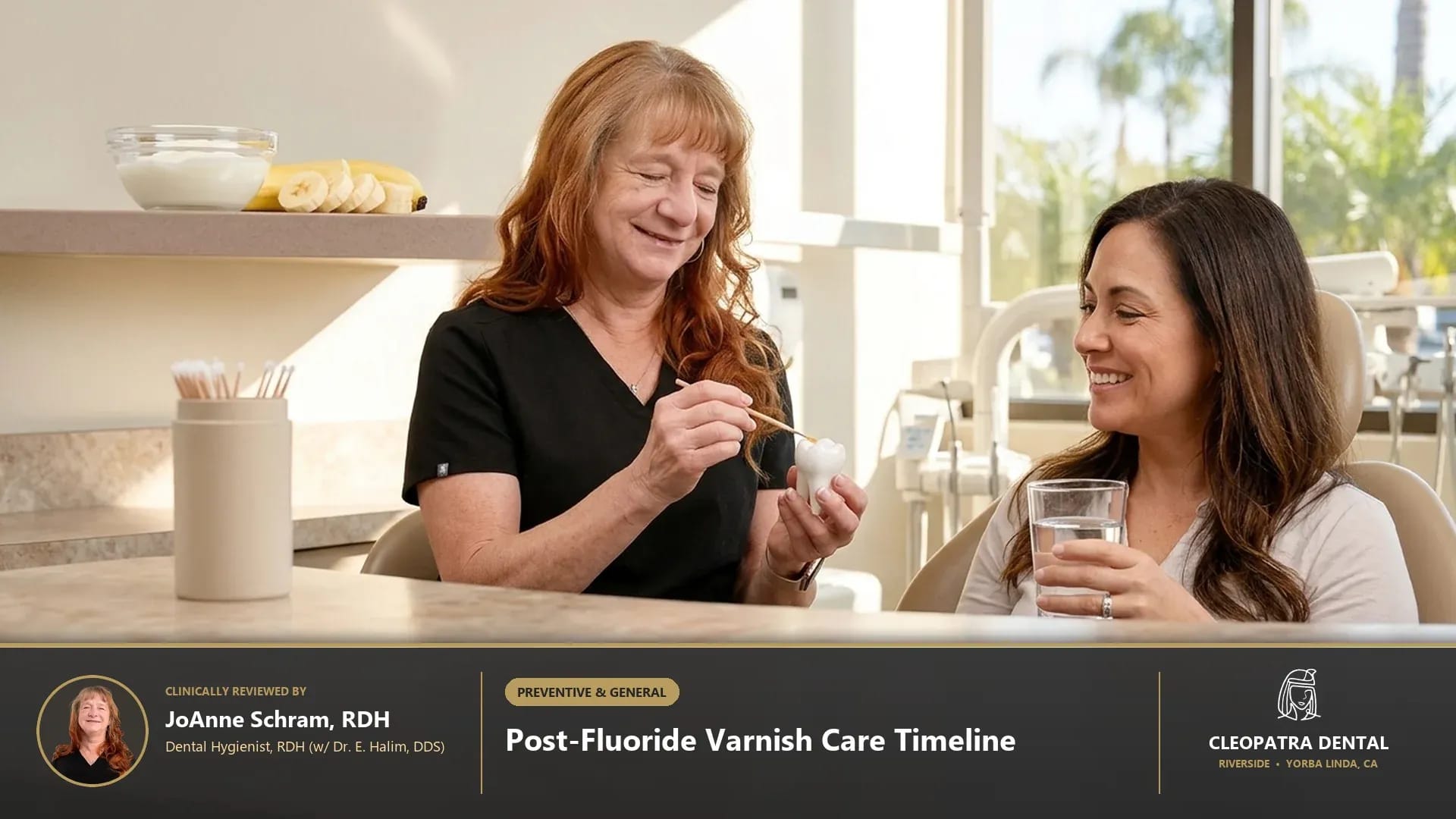
Quick Verified Summary: Periodontal disease begins as reversible gingival inflammation before advancing into destructive periodontitis that permanently breaks down supporting alveolar bone and periodontal ligaments. In Riverside and Yorba Linda, recognizing warning signs like persistent bleeding gums, bad breath, and loose teeth allows for timely intervention. Post-treatment fluoride varnish application rapidly mineralizes exposed root dentin, provided specific dietary protocols are observed.
The Warning Signs of Gum Disease: When Bleeding Gums Signal Danger
Periodontal disease is often called a "silent epidemic" because chronic infection of the gums and supporting bone can progress for years without causing noticeable pain. Many adults mistakenly assume that occasional bleeding when brushing or flossing is normal. At Cleopatra Dental in Riverside and Yorba Linda, our clinical team emphasizes that bleeding gums are never normal; bleeding is the earliest clinical symptom of active microvascular ulceration and bacterial invasion within your periodontal tissues. Strengthening demineralized enamel and calming root sensitivity starts with professional prophylaxis cleanings and topical fluoride varnish. Strengthening demineralized enamel and calming root sensitivity starts with professional prophylaxis cleanings and topical fluoride varnish.
Why Bleeding During Brushing or Flossing Is Never Normal
Healthy gingival epithelium forms a tight, keratinized seal around each tooth. When plaque biofilm accumulates along the cervical margin, bacterial metabolic byproducts trigger severe micro-ulcerations within the pocket lining. The delicate capillaries dilate and rupture easily under minimal mechanical friction—such as brushing or flossing. If your gums bleed, your body's immune system is actively fighting an open wound in your mouth that requires professional evaluation. For patients with a history of gum recession or bone loss, we integrate 5% sodium fluoride varnish into periodontal maintenance and root sensitivity care. For patients with a history of gum recession or bone loss, we integrate 5% sodium fluoride varnish into periodontal maintenance and root sensitivity care.
Persistent Halitosis, Gum Recession, and Deepened Periodontal Pockets
Beyond bleeding gums, advanced periodontal infection produces distinct warning signs that warrant immediate clinical attention: Learn how pit-and-fissure protection complements topical fluoride in our guide comparing resin-based and glass ionomer dental sealants for cavity prevention. Learn how pit-and-fissure protection complements topical fluoride in our guide comparing resin-based and glass ionomer dental sealants for cavity prevention.
- Chronic Bad Breath (Halitosis): Volatile sulfur compounds (hydrogen sulfide and methyl mercaptan) produced by anaerobic bacteria residing deep within infected pockets cause persistent bad breath that mouthwash cannot mask.
- Gingival Recession: As underlying alveolar bone dissolves, the gum tissue pulls away from the enamel, exposing sensitive, darker yellow tooth roots and making teeth appear "longer."
- Pus or Suppuration: Gentle pressure on the gumline that expresses yellowish exudate indicates active acute infection within the periodontal pocket.
- Changes in Bite Alignment: Teeth that begin to drift, separate, or loosen indicate advanced destruction of the periodontal ligament fibers holding the tooth in the jawbone.
The Four Clinical Stages of Periodontal Disease Progression
The American Academy of Periodontology (AAP) and European Federation of Periodontology (EFP) classify periodontal disease into four distinct clinical stages based on severity, complex bone loss patterns, and systemic risk factors.
Stage 1: Gingivitis — Active Inflammation Without Alveolar Bone Loss
Gingivitis represents the initial, entirely reversible stage of gum disease. Bacterial plaque causes red, swollen gums that bleed upon probing. Crucially, the inflammation remains confined to the soft gingival tissues; diagnostic X-rays reveal zero loss of surrounding alveolar bone, and pocket depths remain within 2 to 3 millimeters. With a professional dental cleaning and improved home oral hygiene, gingivitis resolves completely within 10 to 14 days. Patients managing post-bleaching sensitivity can also review in-office teeth whitening vs. custom desensitizing trays. Patients managing post-bleaching sensitivity can also review in-office teeth whitening vs. custom desensitizing trays.
Stage 2: Mild-to-Moderate Periodontitis — 4 to 5mm Pockets and Early Bone Breakdown
If gingivitis remains untreated, chronic inflammation spreads deeper into the supporting structures. Pathogenic bacteria destroy the junctional epithelium, creating 4 to 5 millimeter periodontal pockets. At this stage, irreversible damage begins: radiographic imaging shows that up to 15% to 33% of the crestal alveolar bone has dissolved. Conservative scaling and root planing (perio maintenance) is required immediately to stop bone resorption.
Stage 3 & 4: Severe to Advanced Periodontitis — Tooth Mobility and Furcation Involvement
In Stage 3 and 4 periodontitis, clinical attachment loss extends beyond 5 millimeters, with bone loss exceeding 33% to 50% or more. Infection invades the furcation areas (the branching zone between roots of multi-rooted molar teeth). Teeth become noticeably loose (mobility Class II or III), chew function collapses, and tooth loss is imminent without comprehensive periodontal debridement and advanced bone regeneration therapies. Understand the biological timeline of biofilm maturation in why six-month preventive dental checkups are essential. Understand the biological timeline of biofilm maturation in why six-month preventive dental checkups are essential.
Systemic Health Connections: Cardiovascular, Diabetic, and Pregnancy Risks
Decades of medical research confirm that periodontal disease is not simply a localized mouth issue; it has profound systemic implications for whole-body health.
Periodontal Pathogens Entering the Systemic Bloodstream
The total surface area of ulcerated pocket epithelium in a patient with moderate periodontitis is equivalent to an open wound the size of an adult palm. Chewing, flossing, or even tooth brushing pushes virulent bacteria (like P. gingivalis) directly into the systemic bloodstream (transient bacteremia). These bacteria produce systemic inflammatory markers, including C-reactive protein (CRP) and interleukin-6 (IL-6), which contribute to arterial endothelial dysfunction, atherosclerosis, and increased risk of myocardial infarction and ischemic stroke.
The Two-Way Link Between Uncontrolled Glycemic Levels and Gum Disease
Diabetes and periodontitis have a well-documented bidirectional relationship. Uncontrolled blood sugar (elevated HbA1c levels) leads to microvascular damage in gingival capillaries, impairing immune defense and accelerating periodontal bone breakdown. In turn, chronic periodontal inflammation increases systemic insulin resistance, making glycemic control much more difficult for diabetic patients. Treating gum disease often lowers HbA1c levels significantly.
Professional Fluoride Varnish Therapy: Hour-by-Hour Patient Eating Guide
Following periodontal therapy or scaling, exposed root surfaces frequently experience thermal sensitivity. Professional application of 5% sodium fluoride (NaF) varnish desensitizes exposed dentinal tubules and remineralizes fragile cementum.
How 5% Sodium Fluoride (NaF) Varnish Desensitizes Exposed Root Surfaces
Modern fluoride varnish contains 22,600 parts per million (ppm) of fluoride suspended in a natural resin base. Applied chairside with a micro-brush, the varnish immediately precipitates onto moist enamel and exposed root cementum upon contact with saliva. The high fluoride concentration forms microscopic calcium fluoride (CaF2) crystals that physically plug open dentinal tubules, eliminating temperature sensitivity while reinforcing enamel with acid-resistant fluorapatite.
Immediate Post-Treatment Protocol: Soft, Cool Foods Allowed
Unlike older APF foam or gel treatments that required patients to wait 30 minutes before drinking water, modern 5% NaF varnish sets instantly in the presence of saliva. Patients can drink cool water and eat soft, cool or room-temperature foods immediately after leaving our Riverside or Yorba Linda office.
What to Avoid for 4 to 6 Hours: Hot Beverages, Alcohol, Brushing, and Hard Foods
To maximize fluoride uptake into the tooth crystalline structure, the thin varnish film must remain undisturbed on the teeth for at least 4 to 6 hours (or overnight):
- Avoid Hot Liquids: Coffee, hot tea, hot soup, and boiling beverages can melt the protective varnish layer prematurely.
- Avoid Hard, Crunchy, or Sticky Foods: Chips, nuts, hard pretzels, caramel, and chewy candies will scrape the varnish off the enamel.
- Avoid Alcoholic Beverages: Alcohol acts as a solvent and can dissolve the natural resin carrier before the fluoride is fully absorbed.
- No Brushing or Flossing: Do not brush or floss your teeth for at least 4 to 6 hours (preferably wait until the following morning). When you brush the next day, any remaining yellow or cloudy film easily brushes away, leaving silky-smooth, remineralized enamel.
2026 Gum Disease Therapy Costs and Insurance Coverage in Southern California
Early diagnosis and conservative periodontal therapy represent the most cost-effective approach to preserving natural teeth and avoiding complex prosthodontic or implant surgery. Schedule your biannual prophylaxis and fluoride varnish application with our Yorba Linda dental hygiene team. Schedule your biannual prophylaxis and fluoride varnish application with our Yorba Linda dental hygiene team.
Cost Breakdown for Gingivitis Debridement, SRP, and Fluoride Treatments
Cleopatra Dental provides transparent fee schedules for all preventive and periodontal procedures under standard ADA CDT coding: Inland Empire patients receive the same gentle enamel remineralization protocols at our Riverside preventive dental clinic. Inland Empire patients receive the same gentle enamel remineralization protocols at our Riverside preventive dental clinic.
Important Pricing Note: The prices shown in the table below are estimated ranges; to obtain accurate pricing tailored to your specific clinical needs and insurance coverage, please contact our Riverside or Yorba Linda office.
| CDT Code | Periodontal / Preventative Service | Estimated Cost (Riverside & Yorba Linda, CA) | PPO Insurance Benefits |
|---|---|---|---|
| D4346 | Scaling in Presence of Generalized Moderate / Severe Gingival Inflammation | $140 – $220 | 80% – 100% (Preventative / Basic) |
| D4341 | Periodontal Scaling and Root Planing — 4+ Teeth per Quadrant | $220 – $380 | 50% – 80% (Periodontal Benefit) |
| D4910 | Periodontal Maintenance (Ongoing 3–4 Month Care) | $140 – $230 | 50% – 80% (2 to 4 Visits per Year) |
| D1206 | Topical Application of Fluoride Varnish (Therapeutic) | $40 – $75 | Covered 100% for Kids; Varies for Adults |
| D0180 | Comprehensive Periodontal Oral Evaluation | $95 – $175 | 80% – 100% (Diagnostic Coverage) |
Maximizing Dental PPO Benefits and Health Savings Accounts (HSA/FSA)
Most dental PPO plans cover periodontal treatments as basic or major services. If scaling and root planing is required, our office submits diagnostic pocket charting and digital radiographs to your insurer to ensure maximum claim approval. Periodontal therapies and prescription fluoride treatments also qualify as eligible medical expenses under Health Savings Accounts (HSA) and Flexible Spending Accounts (FSA), allowing you to pay with pre-tax dollars.
Frequently Asked Questions About Gum Disease and Fluoride Therapy
Can gum disease be cured once bone loss has occurred?
While destroyed alveolar bone does not naturally grow back on its own, periodontal disease can be completely arrested and stabilized. Thorough scaling and root planing followed by strict 3-month periodontal maintenance stops bacterial infection, reduces pocket depths, and prevents further bone loss, allowing you to keep your natural teeth for life.
Why can't I brush my teeth right after getting a fluoride varnish treatment?
Fluoride varnish needs 4 to 6 hours of continuous contact with enamel and exposed cementum to maximize remineralization and crystal formation. Brushing too early removes the resin coating before the therapeutic fluoride ions have penetrated the tooth structure.
Is gum disease contagious between spouses or family members?
While periodontitis itself is an inflammatory response to bacterial plaque, the specific virulent anaerobic bacteria (such as P. gingivalis) can be passed between family members through saliva sharing (such as kissing or sharing utensils). If one partner has severe periodontitis, both partners should undergo periodontal screening.
What happens if I ignore bleeding gums for several years?
Untreated gingivitis gradually evolves into chronic periodontitis. Over several years, the supporting jawbone quietly dissolves, resulting in severe gum recession, loose teeth, painful periodontal abscesses, and eventual tooth loss requiring extensive dentures or implants.
Verified Branch & Location: Visit Cleopatra Dental in Yorba Linda at 18651 Yorba Linda Blvd, Yorba Linda, CA 92886 (serving East Lake Village, Travis Ranch, Bryant Ranch, Kerrigan Ranch, Anaheim Hills, and Placentia near Yorba Linda Blvd and Imperial Hwy), or view directions and verified patient reviews on Cleopatra Dental Yorba Linda hygiene clinic on Google Maps.
Clinically & Technically Reviewed By:
Dr. Engy Halim, DDS, BDS — DDS - BDS, Supervising Clinical General Dentist
JoAnne Schram, RDH, BVoc, MEA — Registered Dental Hygienist, RDH, BVoc, MEA
Tiffany Anderson, RDH — Registered Dental Hygienist, RDH, BBA
Medical Disclaimer: This content is clinically reviewed for educational purposes in accordance with American Dental Association (ADA) and Dental Board of California guidelines and does not replace a direct in-person dental examination.