Snap-On Implant Overdentures vs. Traditional Dentures in Riverside, CA
October 24, 2026
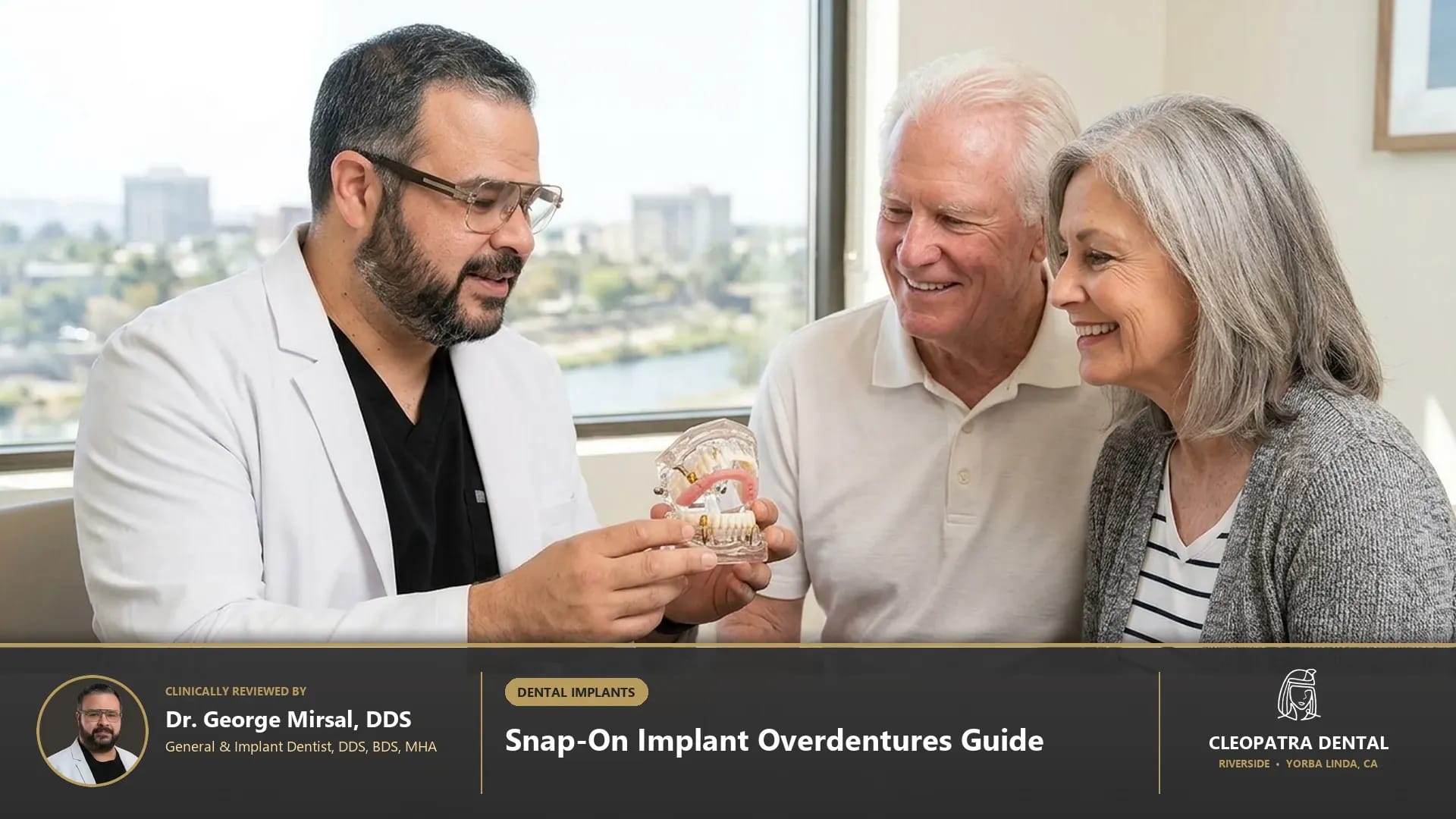
Quick Verified Summary: Replacing missing teeth requires balancing adjacent tooth conservation, alveolar bone preservation, longevity, and financial investment. While traditional fixed dental bridges rapidly restore chew function without surgery, dental implants and implant-supported overdentures provide essential osteocyte stimulation that prevents progressive jawbone resorption. In Riverside, both therapies deliver dependable restorations customized to patient bone volume and systemic health.
The Biological and Functional Impact of Missing Teeth
When an adult tooth is lost to dental trauma, severe decay, or periodontal disease, the biological consequences extend far beyond a visible gap in your smile. The oral masticatory system is an interconnected biomechanical structure. At Cleopatra Dental in Riverside, Dr. George Mirsal and our restorative clinical team guide patients through the critical biological trade-offs between fixed dental bridges, single-tooth dental implants, and implant-stabilized overdentures. Eliminate loose denture adhesives and palatal gagging with implant-supported snap-on overdentures anchored to titanium fixtures. Eliminate loose denture adhesives and palatal gagging with implant-supported snap-on overdentures anchored to titanium fixtures.
Alveolar Bone Resorption and Residual Ridge Atrophy Mechanics
The alveolar bone ridge that surrounds natural teeth is tooth-dependent tissue. Natural tooth roots transmit mechanical biting loads into the jawbone, stimulating osteoblast activity and maintaining bone density through Wolff's Law of bone remodeling. When a tooth root is removed, the local bone no longer receives biomechanical stimulation. Within the first twelve months following an extraction, the alveolar ridge loses up to 25% of its bone width, with gradual vertical height loss continuing indefinitely. This progressive resorption can alter facial architecture, cause sunken lips, and complicate future tooth replacement. We also design precision-fit custom full and partial dentures engineered for balanced occlusion and natural facial support. We also design precision-fit custom full and partial dentures engineered for balanced occlusion and natural facial support.
Adjacent Tooth Migration, Super-Eruption, and Occlusal Instability
Empty spaces left unaddressed cause neighboring teeth to drift, tip, and rotate into the void. Simultaneously, the opposing tooth in the opposite dental arch begins to super-erupt (extrude downward or upward), seeking occlusal contact. This multi-directional tooth shifting creates food impaction zones, accelerates localized periodontal pocketing, and causes traumatic occlusal interferences that can trigger temporomandibular joint pain. Patients who prefer a permanently screw-retained bridge over a removable overdenture can explore fixed All-on-4 full-arch dental implants in Riverside. Patients who prefer a permanently screw-retained bridge over a removable overdenture can explore fixed All-on-4 full-arch dental implants in Riverside.
Fixed Dental Bridges: Mechanism, Enamel Preparation, and Clinical Profile
A traditional fixed dental bridge consists of a prosthetic replacement tooth (a pontic) suspended between two or more crowning abutments cemented onto healthy teeth bordering the gap. Bridges have served as a trusted restorative solution for decades, especially for patients who wish to avoid oral surgery or who possess medical contraindications to surgical implant placement.
Abutment Tooth Preparation and Irreversible Enamel Reduction
The most significant clinical consideration with a traditional bridge is the irreversible reduction required on neighboring abutment teeth. Even if the adjacent teeth are perfectly healthy and virgin (free from decay or fillings), approximately 1.0 to 1.5 mm of circumferential enamel must be removed to accommodate the supporting crowns. If one of the abutment teeth develops a cavity or fracture years later, the entire multi-unit bridge must be removed and replaced. Review our side-by-side biomechanical breakdown comparing All-on-X fixed bridges and removable overdentures. Review our side-by-side biomechanical breakdown comparing All-on-X fixed bridges and removable overdentures.
Pontic Hygiene Challenges: Specialized Floss Threaders and Water Flossers
Because a fixed bridge is manufactured as a solid, unified unit, standard dental floss cannot pass directly through the contact points down to the gumline. Patients must utilize specialized floss threaders, superfloss, or interdental brushes to thread floss underneath the pontic daily. Plaque accumulation under the pontic remains a leading cause of gingival inflammation and recurrent root decay on abutment teeth.
Average Bridge Lifespan and Risk of Recurrent Abutment Decay
The average clinical lifespan of a well-maintained porcelain or zirconia fixed bridge ranges from 10 to 15 years. Longitudinal dental studies indicate that approximately one in three bridge abutment teeth eventually requires endodontic therapy or suffers recurrent caries at the restorative margin over a 15-year observation period. For additional prosthetic design insights, read five essential facts to know about modern cosmetic dentures. For additional prosthetic design insights, read five essential facts to know about modern cosmetic dentures.
Single and Multi-Unit Dental Implants: The Gold Standard in Bone Preservation
Dental implants have revolutionized tooth replacement by providing an artificial root that integrates directly into the jawbone, effectively replicating natural dental anatomy.
Biomimetic Titanium Osseointegration and Trabecular Bone Preservation
A dental implant consists of a medical-grade titanium or zirconia screw surgically placed into the alveolar bone. Through the biological process of osseointegration, living bone cells attach directly to the microscopic porous titanium surface. Chewing forces applied to the implant crown transfer directly into the jawbone, providing the physiologic stimulation required to maintain bone volume and prevent structural facial collapse.
Preserving Virgin Adjacent Teeth from Unnecessary Preparation
Unlike a bridge, an implant is completely self-supporting. The adjacent natural teeth are left 100% untouched, preserving their virgin enamel and biological longevity. Furthermore, patients can brush and floss an implant crown exactly like a natural tooth, simplifying daily home oral hygiene.
| Restorative Factor | Fixed Dental Bridge | Single Dental Implant | Snap-On Implant Overdenture |
|---|---|---|---|
| Surgical Requirement | Non-Surgical (2 Visits) | Minor Surgical Placement | 2 to 4 Implants Placed |
| Bone Preservation | None (Bone Resorbs Under Pontic) | 100% Stimulation & Maintenance | High Anterior Bone Preservation |
| Impact on Adjacent Teeth | Requires Enamel Preparation | Zero Impact on Adjacent Teeth | Stabilizes Remaining Dentition |
| Average Lifespan | 10 – 15 Years | 25+ Years to Lifetime | 15 – 20+ Years (Caps Replaced) |
| Flossing & Cleaning | Floss Threader Under Pontic | Normal Floss Like Natural Tooth | Removable Nightly for Cleansing |
Snap-On Implant Overdentures vs. Traditional Removable Dentures
For patients missing multiple teeth or experiencing total edentulism (complete tooth loss) in an entire dental arch, our snap-on dentures and dentures programs offer life-changing restorative alternatives.
Why Traditional Complete Dentures Accelerate Mandibular Bone Collapse
Traditional removable complete dentures rely solely on suction and the slippery mucosa of the gum ridge for retention. As the lower jaw undergoes continuous bone resorption, traditional dentures lose their fit, leading to painful friction sores, slipping while speaking, and difficulty chewing healthy foods like fresh fruits and vegetables. Worse, the constant resting pressure of a loose denture actually accelerates residual ridge resorption over time.
Locator Attachment Systems: Restoring 70% Chewing Efficiency
Snap-on overdentures resolve instability by anchoring a removable denture onto two to four strategically placed dental implants using specialized Locator abutments. The underside of the denture contains precision housing units with resilient nylon caps that snap securely onto the implant abutments with a satisfying tactile click. This anchors the denture firmly during chewing and speaking, increasing masticatory efficiency from 20% (with traditional dentures) up to 70% or more.
Routine Maintenance: Replacing Nylon Retention Caps Every 12 to 18 Months
A snap-on overdenture is designed to be easily removed by the patient at night for thorough cleaning and oral tissue rest. The only ongoing maintenance required is the routine chairside replacement of the internal nylon male retention inserts (CDT D5862). Over 12 to 18 months of daily snapping on and off, these medical-grade nylon caps gradually wear down. Replacing them takes just five minutes in our operatory and instantly restores factory-fresh retention.
2026 Cost and Longevity Comparison in Riverside & Yorba Linda
When evaluating the financial commitment of missing tooth replacement, patients should consider both the initial procedural cost and the 20-to-25 year cumulative investment. While a traditional bridge may present lower upfront fees, its replacement cycle every 10 to 15 years often makes a dental implant more cost-effective over a lifetime. Locator abutment retrofits and 3D CBCT overdenture planning are performed at our Riverside denture and implant center. Locator abutment retrofits and 3D CBCT overdenture planning are performed at our Riverside denture and implant center.
Initial Out-of-Pocket Cost vs. 25-Year Cumulative Financial Investment
A single dental implant involves the surgical fixture (D6010), custom abutment (D6058), and implant crown (D6058/D6065). While the initial fee may be slightly higher than a 3-unit bridge, the implant typically lasts a lifetime with proper care, whereas a bridge may require replacement twice during the same time horizon. Patients in Orange County can also schedule snap-on overdenture consultations at our Yorba Linda implant denture clinic. Patients in Orange County can also schedule snap-on overdenture consultations at our Yorba Linda implant denture clinic.
Important Pricing Note: The prices shown in the table below are estimated ranges; to obtain accurate pricing tailored to your specific clinical needs and insurance coverage, please contact our Riverside or Yorba Linda office.
| CDT Code | Tooth Replacement Procedure | Estimated Cost (Riverside & Yorba Linda, CA) | Longevity Expectancy |
|---|---|---|---|
| D6245 | Pontic — Porcelain / Ceramic Substrate (per unit) | $1,050 – $1,550 | 10 – 15 Years |
| D6740 | Retainer Crown — Porcelain / Ceramic (per abutment) | $1,050 – $1,550 | 10 – 15 Years |
| D6010 | Surgical Placement of Implant Body: Endosteal Implant | $1,800 – $2,600 | Lifetime Potential (98% Success) |
| D6058 | Abutment Supported Porcelain / Ceramic Crown | $1,400 – $1,950 | 15 – 25+ Years |
| D6111 | Mandibular Implant Supported Overdenture (Lower Snap-On) | $4,500 – $8,500 | 15 – 20+ Years (Prosthesis) |
| D5862 | Replacement of Implant Retention Insert (per snap) | $65 – $120 | Routine 12 – 18 Month Maintenance |
Insurance Codes (CDT), PPO Coverage, and Staged Treatment Financing
Most dental PPO plans cover 50% of the cost of both fixed bridges and implant restorations, subject to annual maximums (typically $1,500 to $2,500 per calendar year). At Cleopatra Dental, our financial coordinators help patients phase restorative care across benefit years to maximize insurance reimbursements. We also partner with CareCredit and Proceed Finance to provide flexible, low-monthly-payment financing plans with 0% interest promotions.
Frequently Asked Questions: Bridge vs. Implant vs. Snap-On Dentures
Which option lasts longer: a dental bridge or an implant?
Dental implants offer significantly greater longevity. Over 95% to 98% of dental implants remain functional and healthy after 20 years, often lasting a lifetime. Traditional fixed bridges average 10 to 15 years before recurrent decay on the abutment teeth or structural fatigue requires replacement.
Can I upgrade from traditional dentures to snap-on implant overdentures later?
Yes. Many patients begin with traditional dentures and choose to upgrade to snap-on overdentures once they experience the limitations of suction-based retention. We perform a 3D CBCT scan to evaluate remaining jawbone volume and place two to four implants to anchor your existing or new custom overdenture.
Does getting a dental implant hurt more than preparing a dental bridge?
Surprisingly, most patients report that receiving a dental implant involves less post-operative discomfort than having adjacent teeth ground down for a bridge. Implant surgery is performed under local anesthesia with precise 3D surgical guides. Discomfort afterwards is mild and typically subsides within two to three days with over-the-counter pain relievers.
Can I get a dental implant if I have been missing a tooth for several years?
Yes. If bone loss has occurred during the years since tooth extraction, Dr. George Mirsal can perform localized ridge preservation or bone grafting to rebuild bone width and height prior to or during implant placement.
Verified Branch & Location: Visit Cleopatra Dental in Riverside at 2955 Van Buren Boulevard, Ste H4, Riverside, CA 92503 (serving Arlington, La Sierra, Canyon Crest, Wood Streets, Orangecrest, and Corona near Van Buren Blvd and CA-91), or view directions and verified patient reviews on Cleopatra Dental Riverside implant dentures on Google Maps.
Clinically & Technically Reviewed By:
Dr. George Mirsal, DDS, BDS, MHA — DDS - BDS - MHA, Clinical General Dentist
Medical Disclaimer: This content is clinically reviewed for educational purposes in accordance with American Dental Association (ADA) and Dental Board of California guidelines and does not replace a direct in-person dental examination.