All-on-4 & Full-Arch Dental Implants in Riverside, CA: 2026 Cost & Guide
October 15, 2026
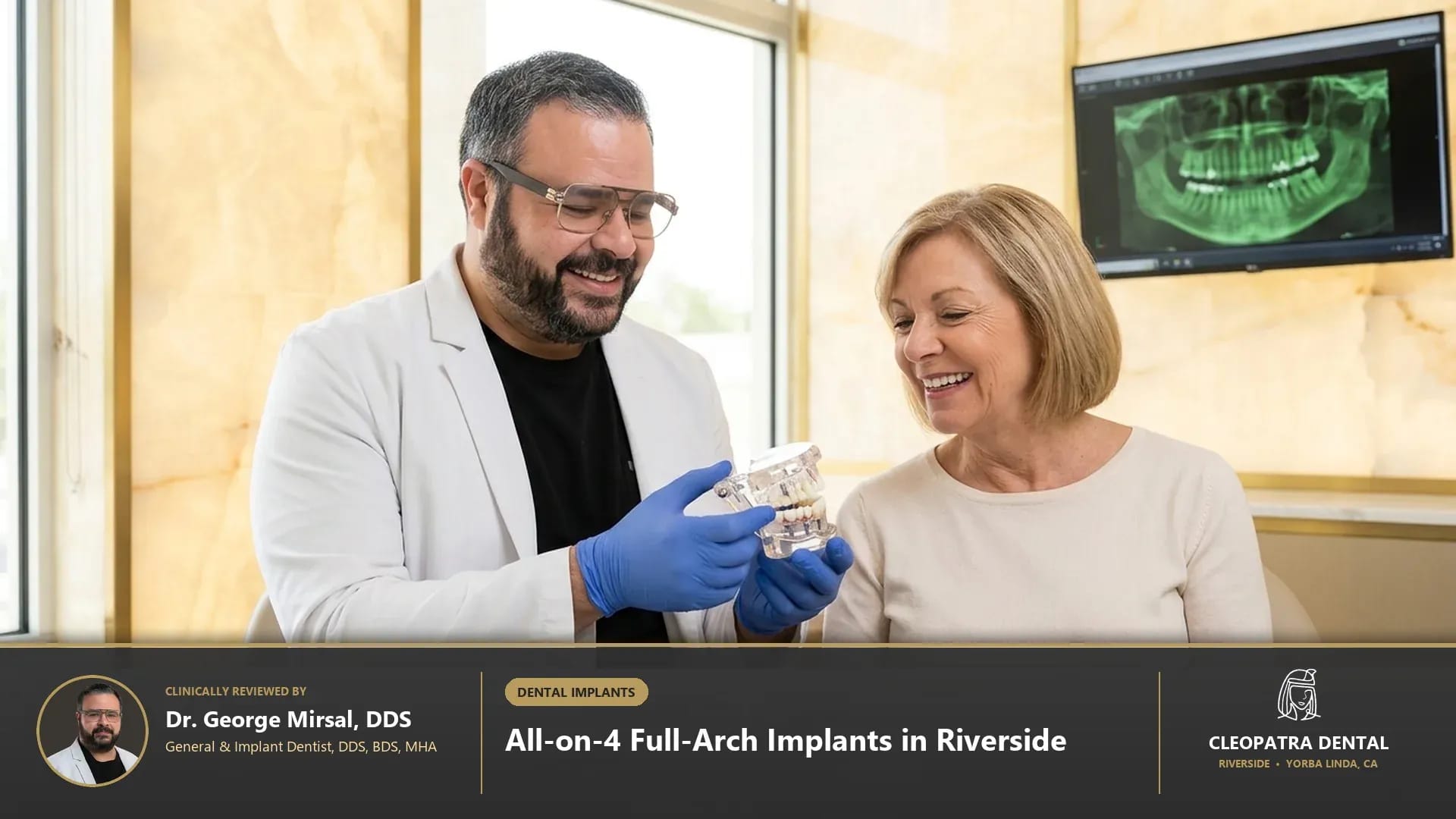
Quick Verified Summary: All-on-4 dental implants in Riverside and Yorba Linda restore full-arch edentulous smiles in a single surgical session using four to six strategically angled biocompatible titanium fixtures. Guided by 3D cone-beam computed tomography (CBCT), this treatment achieves over 98% long-term success while eliminating the requirement for complex pre-implant sinus bone grafting.
Understanding All-on-4 and Full-Arch Implant Rehabilitation
Full-arch rehabilitation represents a transformative advancement in restorative oral surgery for patients in Riverside, CA suffering from terminal dentition, advanced periodontal disease, or severe bone resorption. Unlike traditional removable dentures that rest precariously on the gingival ridge and accelerate bone loss through chronic compression, the All-on-4 protocol anchors a fixed, non-removable prosthetic bridge directly into dense cortical bone. By tilting posterior implants up to 45 degrees, clinicians bypass anatomical limitations such as the maxillary sinus cavity in the upper jaw and the mental foramen in the lower jaw. Patients seeking permanent full-arch restoration can explore our specialized All-on-X full-arch implant solutions. Patients seeking permanent full-arch restoration can explore our specialized All-on-X full-arch implant solutions.
The Biomechanical Architecture of Angled Implants
The biomechanical stability of an All-on-4 system depends on creating an expansive anterior-posterior (AP) spread. Angling the posterior fixtures increases bone-to-implant contact along cortical bone plates while keeping the prosthetic cantilever under 10 to 12 millimeters. This mechanical distribution prevents excessive bending moments on the implants during mastication, ensuring even distribution of occlusal forces whether chewing dense foods or speaking naturally. Biomechanical studies confirm that this geometry reduces stress concentration at the crestal bone margin by more than 30% compared to axially placed short implants in resorbed posterior ridges. Our surgical team also designs individual custom dental implant restorations for single and multiple missing teeth. Our surgical team also designs individual custom dental implant restorations for single and multiple missing teeth.
Primary Stability and Immediate Loading Thresholds
To safely secure a provisional full-arch bridge on the day of surgery, each placed fixture must attain a primary insertion torque of at least 35 to 45 Ncm, accompanied by an Implant Stability Quotient (ISQ) exceeding 65. When these rigorous biometric parameters are fulfilled during 3D guided surgery at Cleopatra Dental in Riverside, patients receive an immediate, non-removable PMMA acrylic prosthesis within 24 hours of fixture placement, restoring aesthetics and oral function immediately. For a deeper look at multi-implant configurations, read our clinical breakdown on how All-on-X dental implants compare in 2026. For a deeper look at multi-implant configurations, read our clinical breakdown on how All-on-X dental implants compare in 2026.
3D CBCT Surgical Planning and Digital Workflow
Precision execution in modern implantology eliminates guesswork. Prior to any surgical intervention, patients undergo high-resolution cone-beam computed tomography (CBCT) under ADA CDT code D0367 paired with high-definition optical intraoral surface scanning. This combined DICOM and STL dataset generates a virtual anatomical twin of the patient's craniofacial structures, allowing precise simulation of nerve pathways, bone volume, and emergency surgical safety margins.
Static Computer-Generated Surgical Guides
Using 3D implant planning software, surgeons fabricate custom stereolithographic surgical guides that seat rigidly against remaining teeth or native cortical bone. These custom guides direct pilot drills and osteotomy burs along pre-planned three-dimensional angulations and depths with sub-millimeter precision. This computer-assisted protocol reduces intraoperative surgical flap reflection, minimizes microvascular disruption, and substantially lowers postoperative edema and discomfort. Flapless or minimally invasive flap elevations preserve the periosteal blood supply, accelerating soft tissue healing around multi-unit abutments. When severe bone resorption is present, review our patient comfort guide explaining whether ridge augmentation and sinus lifts are painful. When severe bone resorption is present, review our patient comfort guide explaining whether ridge augmentation and sinus lifts are painful.
Bone Density Assessment Across Misch Classifications
Cortical and trabecular bone density dictates surgical osteotomy protocols. Misch Type I and II bone commonly found in the anterior mandible offers exceptional primary mechanical stability. Conversely, Type III and Type IV bone characteristic of the posterior maxilla requires under-drilling osteotomy techniques and tapered implant bodies to condense adjacent trabeculae and achieve sufficient insertion torque without inducing pressure necrosis.
Clinical Comparison: All-on-4 vs. Traditional Removable Dentures
Evaluating tooth replacement options requires examining longevity, bone preservation, masticatory efficiency, and daily maintenance demands. Patients transitioning from ill-fitting prosthetics frequently report substantial improvements in nutritional intake and systemic health after securing a fixed implant bridge. Patients comparing fixed bridges with removable options can explore our guide on securing removable dentures with dental implants. Patients comparing fixed bridges with removable options can explore our guide on securing removable dentures with dental implants.
| Clinical Parameter | Fixed All-on-4 Implants | Traditional Removable Dentures | Snap-On Implant Overdentures |
|---|---|---|---|
| Alveolar Bone Preservation | Stimulates bone through direct osseointegration; halts resorption | Continuous vertical bone loss due to chronic soft-tissue compression | Moderate preservation localized around retaining implant attachments |
| Masticatory Bite Force | Restores 85% to 95% of natural chewing capacity | Provides only 15% to 25% of baseline chewing efficiency | Restores 50% to 65% of normal chewing function |
| Prosthetic Stability | Rigidly screwed into multi-unit abutments; zero slippage | Prone to displacement, requiring adhesives and relining | Snaps securely onto locator abutments; removable for cleaning |
| Palatal Coverage | Zero roof-of-mouth coverage; natural taste and temperature sensation | Full acrylic palate impairs taste, speech, and thermal perception | Horseshoe design eliminates palatal acrylic coverage |
| Expected Service Life | Titanium posts last 25+ years to a lifetime; bridge relined/replaced at 10-15 years | Requires complete replacement every 5 to 7 years due to tissue changes | Nylon locator inserts replaced annually; denture base lasts 7-10 years |
2026 Full-Arch Implant Cost Guide in Riverside and Orange County
Understanding the financial investment required for full-arch dental implants requires clear transparency regarding surgical staging, prosthetic components, laboratory fabrication fees, and regional Southern California dental economics. At our practice, every patient receives a comprehensive, itemized diagnostic treatment plan prior to initiating surgery.
Important Pricing Note: The prices shown in the table below are estimated ranges; to obtain accurate pricing tailored to your specific clinical needs and insurance coverage, please contact our Riverside or Yorba Linda office.
| Procedure Phase & ADA CDT Code | Estimated Cost Range (Per Arch) | Coverage & Financing Options |
|---|---|---|
| 3D CBCT Diagnostic Imaging & Digital Guide (D0367 / D6190) | $450 – $950 | Often partially reimbursable under major medical or dental PPO diagnostic benefits |
| Surgical Placement of 4 Endosteal Fixtures (D6010 x 4) | $6,500 – $9,800 | Covered under select PPO dental policies; 0% APR CareCredit financing available |
| Same-Day Immediate Fixed Provisional Prosthesis (D6114 / D6115) | $3,200 – $4,500 | Included in comprehensive surgical package; HSA and FSA eligible funds applicable |
| Definitive Monolithic Zirconia Titanium Bridge (D6114 / D6115) | $12,500 – $18,500 | Long-term financing up to 60 months with LendingClub and Proceed Finance |
| Complete Single-Arch All-on-4 Treatment (Turnkey Package) | $22,500 – $29,500 | Comprehensive bundle covering extractions, surgery, temporary, and final zirconia arch |
Insurance Optimization and Financing Arrangements
While standard dental insurance plans typically categorize full-arch implant reconstruction under major restorative benefits with annual maximum caps between $1,500 and $2,500, specific procedural elements—including pre-surgical extractions, bone alveoloplasty, and CT scans—may qualify for partial reimbursement under dental or medical insurance. Cleopatra Dental participates with major PPO providers and offers zero-interest financing through CareCredit, Proceed Finance, and LendingClub to structure predictable monthly investments.
Surgical Protocol and Osseointegration Timeline
The transition from diseased dentition to a permanent, functional smile proceeds through well-defined biological phases designed to ensure bone regeneration, soft tissue emergence profiling, and lasting prosthetic integration. Each phase is monitored through clinical assessments and digital radiologic evaluations.
Phase 1: Diagnostic Evaluation and Surgical Execution
During the primary surgical appointment, any remaining non-restorable teeth are atraumatically extracted under IV sedation or profound local anesthesia. The oral surgeon recontours the alveolar ridge via alveoloplasty to create a level prosthetic foundation. Four to six medical-grade titanium fixtures are positioned according to the stereolithographic guide, followed by the torque-controlled attachment of angled multi-unit abutments.
Phase 2: Same-Day Immediate Provisionalization
A customized rigid provisional prosthesis fabricated from high-density PMMA acrylic is screw-retained to the multi-unit abutments. This fixed temporary splints the implants together during the vulnerable early healing period, preventing micromovement while allowing the patient to speak clearly and consume a soft-food diet on the same evening of surgery.
Phase 3: Biological Osseointegration (3 to 6 Months)
Over the following 12 to 24 weeks, living osteoblasts proliferate around the micro-textured titanium surface, creating structural and functional anchoring between living bone and the load-bearing fixture. Patients adhere to post-operative hygiene protocols, avoiding mechanical overload on the provisional restoration while bone remodels around the threads.
Phase 4: Definitive Zirconia Arch Delivery
Once clinical and radiographic osseointegration is confirmed, digital impressions capture the mature peri-implant emergence profile. The dental laboratory mills the final prosthesis from a solid disc of pre-shaded monolithic zirconia, renowned for high flexural strength (exceeding 1,100 MPa) and lifelike optical translucency, secured via concealed prosthetic screws.
Post-Operative Care and Long-Term Maintenance
Protecting your implant investment requires rigorous maintenance protocols to prevent peri-implant mucositis and irreversible peri-implantitis. Every phase of 3D-guided full-arch surgery is performed in-house at Cleopatra Dental in Riverside. Every phase of 3D-guided full-arch surgery is performed in-house at Cleopatra Dental in Riverside.
Immediate 72-Hour Healing Protocol
During the first three days post-surgery, patients apply external cold compresses in 20-minute intervals to mitigate facial swelling. Strenuous physical exertion, smoking, and vigorous mouth rinsing must be avoided. A lukewarm soft diet—including smoothies, scrambled eggs, broths, and yogurt—prevents mechanical stress on the newly placed implants. Patients in North Orange County can also schedule full-arch evaluations at our Yorba Linda implant center. Patients in North Orange County can also schedule full-arch evaluations at our Yorba Linda implant center.
Routine Daily Hygiene and Professional Maintenance Schedules
Long-term success requires daily plaque biofilm debridement using a specialized water flosser, interdental sulcus brushes, and non-abrasive antimicrobial mouth rinses. Patients visit our clinic every four to six months for professional hygiene appointments utilizing non-scratching titanium and carbon-fiber scalers paired with subgingival glycine powder air polishing.
Frequently Asked Questions About All-on-4 Implants in Riverside
How long does the All-on-4 implant surgery take?
The surgical placement of four to six implants per arch, including extractions and the conversion of your immediate provisional prosthesis, typically requires two and a half to four hours per arch under comfortable IV sedation or local anesthesia.
Is the All-on-4 dental implant procedure painful?
Patients experience zero pain during surgery due to profound local anesthesia and twilight sedation. Postoperative discomfort is commonly described as similar to simple tooth extractions and is effectively managed with prescribed or over-the-counter anti-inflammatory analgesics within three to five days.
What is the difference between PMMA temporary and zirconia final bridges?
A provisional PMMA bridge is lightweight acrylic designed to protect healing implants from excessive masticatory torque during osseointegration. The final monolithic zirconia bridge is a permanent, non-porous ceramic that resists chipping, fractures, and staining while providing superior long-term aesthetic beauty.
Can smokers receive All-on-4 dental implants?
While nicotine and carbon monoxide reduce capillary blood flow and increase the risk of implant failure, smoking is not an absolute contraindication. Patients are strongly advised to cease smoking for at least two weeks before and eight weeks following surgery to optimize bone integration.
Verified Branch & Location: Visit Cleopatra Dental in Riverside at 2955 Van Buren Boulevard, Ste H4, Riverside, CA 92503 (serving Arlington, La Sierra, Canyon Crest, Wood Streets, Orangecrest, and Corona near Van Buren Blvd and CA-91), or view directions and verified patient reviews on Cleopatra Dental Riverside Google Business Profile on Google Maps.
Clinically & Technically Reviewed By:
Dr. George Mirsal, DDS, BDS, MHA — General & Implant Dentist
Medical Disclaimer: This content is clinically reviewed for educational purposes in accordance with American Dental Association (ADA) and Dental Board of California guidelines and does not replace a direct in-person dental examination.