TMJ & Jaw Pain Therapy in Riverside & Yorba Linda: Custom Nightguards
October 26, 2026
Quick Verified Summary: Full mouth reconstruction systematically re-establishes healthy masticatory function, structural tooth integrity, and harmonious vertical dimension of occlusion (VDO). For Riverside and Yorba Linda patients experiencing severe enamel attrition, bite collapse, or temporomandibular joint (TMJ) discomfort, general dentists combine custom stabilizing nightguards, digital occlusal diagnostics, crowns, and implants to deliver conservative, life-changing oral rehabilitation.
What Is Full Mouth Reconstruction? Scope and Clinical Objectives
Full mouth reconstruction—frequently termed full mouth rehabilitation or oral reconstruction—is a comprehensive restorative process that addresses complex, multi-quadrant dental breakdowns. Unlike routine cosmetic dentistry that focuses purely on surface smile enhancements, full mouth reconstruction is an evidence-based clinical therapy designed to rebuild structural tooth loss, re-establish physiological bite balance, and resolve chronic jaw dysfunction. At Cleopatra Dental, serving patients across Riverside and Yorba Linda, our general dentists take a conservative, biological approach to complex rehabilitative care. Re-establishing physiological bite harmony often combines conservative splint deprogramming with clear aligner occlusal balancing and bite therapy. Re-establishing physiological bite harmony often combines conservative splint deprogramming with clear aligner occlusal balancing and bite therapy.
Distinguishing Full Mouth Rehabilitation from Purely Cosmetic Makeovers
While an aesthetic smile makeover focuses on the visual harmony of anterior teeth through porcelain veneers or teeth whitening, full mouth reconstruction addresses systemic breakdown across both dental arches. The clinical goal is functional longevity: establishing stable posterior occlusal support, ensuring proper anterior canine guidance, decompressing the temporomandibular joints, and safeguarding remaining natural dentition against future destructive wear. When severe attrition has collapsed vertical dimension, we rebuild posterior support through restorative crown rehabilitation for bruxism-worn teeth. When severe attrition has collapsed vertical dimension, we rebuild posterior support through restorative crown rehabilitation for bruxism-worn teeth.
Restoring Lost Vertical Dimension of Occlusion (VDO)
The Vertical Dimension of Occlusion (VDO) represents the measured vertical distance between the maxilla (upper jaw) and mandible (lower jaw) when the teeth are fully intercuspated. When posterior molars are lost or severely worn down by grinding, the bite collapses, causing the lower third of the face to shorten. This bite collapse results in deep facial wrinkles around the mouth, angular cheilitis at the lip corners, and excessive, destructive shear forces on the anterior teeth. Understand why custom hard acrylic splints outperform soft sports guards in the clinical difference between an athletic mouthguard and a custom TMJ nightguard. Understand why custom hard acrylic splints outperform soft sports guards in the clinical difference between an athletic mouthguard and a custom TMJ nightguard.
Primary Indications: Severe Wear, Acid Erosion, and Bite Collapse
Recognizing the etiology of extensive tooth breakdown allows our clinical team to select conservative restorative materials and design protective therapies that prevent future dental failures.
Nocturnal Bruxism, Attrition, and Enamel Micro-Fractures
Chronic nocturnal clenching and teeth grinding (bruxism) generate sustained forces up to three times higher than daytime chewing. Over years, this mechanical attrition flattens occlusal cusps, exposes vulnerable dentin, and creates micro-cracks throughout the enamel prisms. As dentin wears down seven times faster than outer enamel, rapid hollowed-out cupping lesions develop across the chewing surfaces. Explore reversible myofascial pain protocols in our companion guide to evidence-based conservative treatments for TMJ disorders. Explore reversible myofascial pain protocols in our companion guide to evidence-based conservative treatments for TMJ disorders.
Intrinsic GERD and Dietary Acid Erosion Patterns
Severe tooth destruction is frequently compounded by chemical acid erosion. Gastroesophageal reflux disease (GERD), chronic bulimia, and frequent consumption of acidic beverages (sodas, sports drinks, sparkling waters) lower intraoral pH below the critical threshold of 5.5, chemically dissolving calcium hydroxyapatite crystals. When combined with mechanical bruxism, chemical erosion accelerates tooth destruction at alarming rates.
Loss of Posterior Support and Secondary Anterior Flaring
When molars are extracted and never replaced, the robust posterior biting foundation is lost. The delicate, single-rooted anterior incisors are forced to bear heavy vertical chewing loads they were never biologically designed to support. Consequently, front teeth begin to flare outward, loosen, fracture, and separate, causing aesthetic distress and functional failure. For patients with anterior attrition from deep bites, read how deep overbites and malocclusion impact jaw joint strain. For patients with anterior attrition from deep bites, read how deep overbites and malocclusion impact jaw joint strain.
Temporomandibular Joint (TMJ) Health and Conservative Bite Stabilization
Jaw joint health is intimately connected to occlusal harmony. When teeth are severely worn or misaligned, the condyles of the temporomandibular joint can be forced into a displaced, compressed position within the glenoid fossa, triggering myofascial pain and joint pathology.
Understanding TMD Symptoms: Jaw Clicking, Muscle Spasms, and Ear Fullness
Temporomandibular disorders (TMD) manifest through a variety of distressing symptoms: If heavy nocturnal bruxism has already cracked an existing restoration, see our guide on repairing dental crowns fractured by nighttime clenching. If heavy nocturnal bruxism has already cracked an existing restoration, see our guide on repairing dental crowns fractured by nighttime clenching.
- Audible clicking, popping, or grating (crepitus) within the jaw joint during opening or chewing.
- Chronic tension headaches, temple tightness, and painful morning soreness in the masseter muscles.
- Limited jaw opening or episodes of painful jaw locking.
- Ear symptoms, including ringing (tinnitus), ear fullness, and dull aching without an active ear infection.
- Unexplained cervical neck and shoulder stiffness related to postural compensation.
Conservative, Reversible TMJ Care Provided by General Dentists
Under California Dental Practice Act regulations (CA B&P § 651), ethical dental marketing requires transparent communication: TMJ care is provided by skilled general dentists utilizing conservative, evidence-based protocols rather than unscientific claims of specialty status. In alignment with the National Institute of Dental and Craniofacial Research (NIDCR) and the American Academy of Orofacial Pain (AAOP), our practice strictly prioritizes non-invasive, reversible therapies. Permanent surgical interventions or irreversible bite shavings are avoided in favor of physiological deprogramming and stabilization.
Custom Hard Acrylic Stabilization Splints vs. Over-the-Counter Nightguards
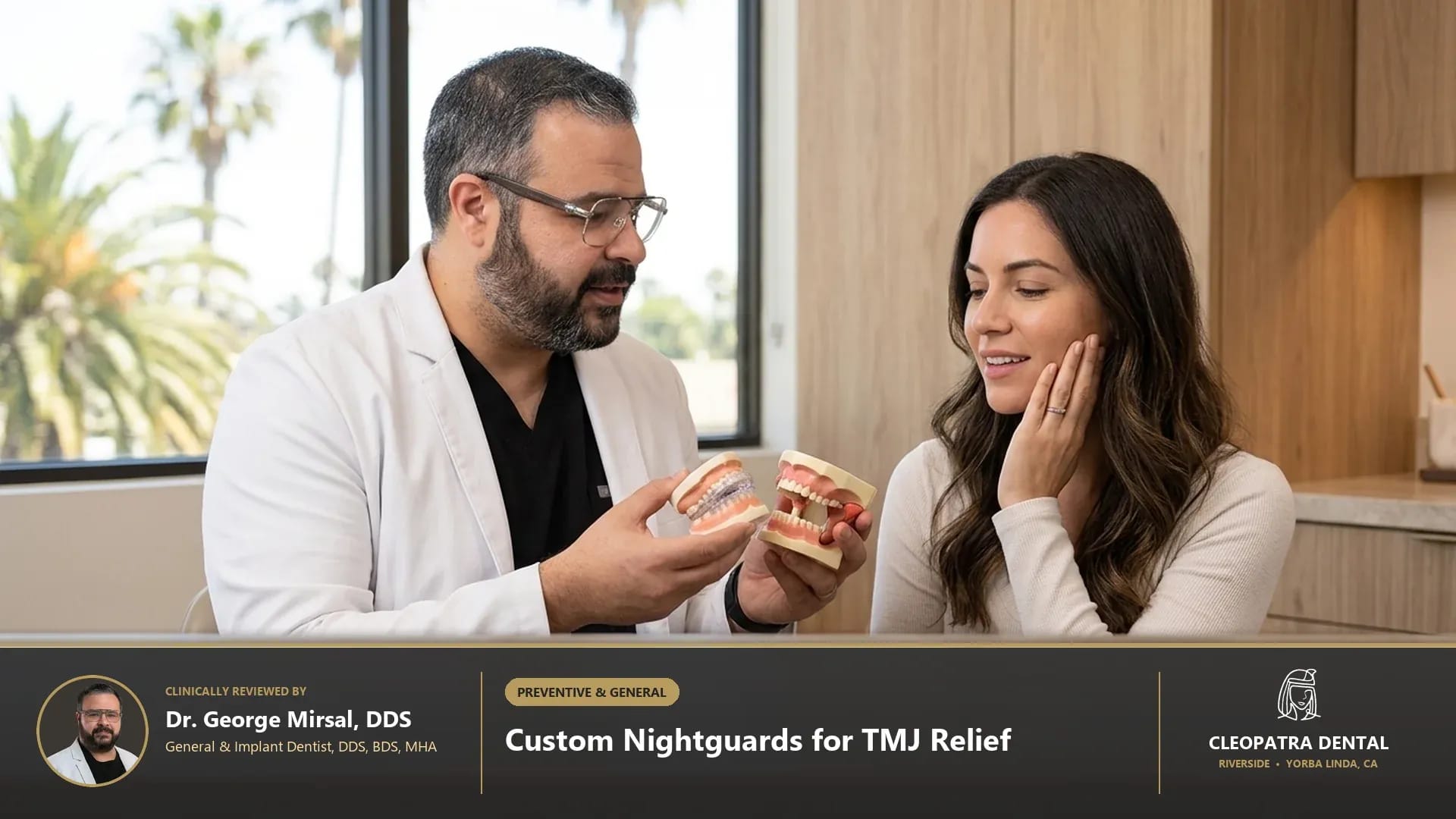
Soft, squishy nightguards purchased over-the-counter often worsen TMJ discomfort because the pliable rubber stimulates chew reflexes, causing patients to clench more aggressively in their sleep. In contrast, our clinical team fabricates custom, laboratory-cured hard acrylic occlusal stabilization splints (CDT D9944). These rigid appliances provide a smooth, flat biting plane with bilateral, balanced contacts and canine guidance, completely disengaging hyperactive masseter muscles and allowing the jaw joints to settle into their natural, unstrained orthopedic position.
Comparing occlusal appliance designs highlights why rigid, laboratory-processed acrylic is essential for neuromuscular deprogramming within a 40 to 50 mm normal interincisal opening range:
| Occlusal Appliance Type | Acrylic Thickness & Material | Masseter EMG Load Reduction | Reversible Stabilization Timeline |
|---|---|---|---|
| Custom Hard Acrylic Stabilization Splint (D9944) | 1.5 – 2.0 mm Heat-Cured PMMA | 25% – 40% nocturnal force reduction | 6 – 12 weeks before VDO evaluation |
| Anterior Deprogrammer (Kois / Lucia Jig) | 2.0 – 2.5 mm Anterior Ramp | 35% – 50% posterior disclusion relief | 2 – 4 weeks Centric Relation verification |
| OTC Soft Thermoplastic Boil-and-Bite Guard | 3.0 – 4.0 mm Pliable EVA Rubber | 0% (often increases clenching by 10% – 20%) | Not indicated for TMJ rehabilitation |
Phase-by-Phase Multidisciplinary Treatment Workflow in Southern California
Rehabilitating an entire dentition requires meticulous planning and staged execution to ensure physiological adaptation and predictable aesthetic outcomes.
Phase 1: Digital 3D Diagnostics, CBCT Imaging, and Deprogramming
The journey begins with comprehensive data acquisition: high-resolution 3D Cone Beam Computed Tomography (CBCT) to evaluate condylar anatomy and airway dimensions, digital optical intraoral scanning, facial photographic analysis, and occlusal deprogramming with a temporary Lucia jig or Kois deprogrammer to determine your true Centric Relation (CR) bite position.
Phase 2: Periodontal Stabilization and Provisional Occlusal Mockups
Before any permanent restorations are fabricated, periodontal foundations must be pristine. Any active gingivitis or periodontitis is treated with deep cleaning, and failing root canal teeth are treated. Our clinicians then place fixed provisional restorations—composite resin or high-strength PMMA mockups—built to your newly calculated vertical dimension. You live with these functional provisionals for several weeks to ensure your jaw joints, speech, and mastication are completely comfortable.
Phase 3: Definitive Indirect Ceramic and Implant Restorations
Once neuromuscular comfort is confirmed, the provisional contours are digitally duplicated into definitive restorations. Depending on individual clinical requirements, this phase may combine monolithic zirconia crowns for posterior molars, delicate IPS e.max onlays to preserve natural tooth structure, dental implants to replace missing roots, or clear aligner therapy (clear aligners) to optimize root positions before crowning.
2026 Full Mouth Reconstruction Costs, Phased Phasing, and Financing
Full mouth reconstruction represents an investment in total health, facial rejuvenation, and masticatory independence. Because every patient's clinical situation is unique, treatment plans are modular and can be phased across multiple benefit years. Conservative occlusal splint fabrication and full-mouth rehabilitation are provided at our Riverside TMJ and occlusal therapy clinic. Conservative occlusal splint fabrication and full-mouth rehabilitation are provided at our Riverside TMJ and occlusal therapy clinic.
Transparent Cost Breakdown and Pertinent CDT Procedure Codes
Our treatment coordinators provide complete clarity regarding expected fees and standard insurance coding: Orange County patients can also schedule TMJ and bite evaluations at our Yorba Linda occlusal rehabilitation office. Orange County patients can also schedule TMJ and bite evaluations at our Yorba Linda occlusal rehabilitation office.
Important Pricing Note: The prices shown in the table below are estimated ranges; to obtain accurate pricing tailored to your specific clinical needs and insurance coverage, please contact our Riverside or Yorba Linda office.
| CDT Code | Rehabilitative Procedure Description | Estimated Cost (Riverside & Yorba Linda, CA) | Clinical Scope & Function |
|---|---|---|---|
| D9944 | Occlusal Guard — Hard Construction, Full Arch | $550 – $950 | Joint Deprogramming & Nighttime Protection |
| D9951 | Occlusal Adjustment — Limited (Equilibration) | $180 – $350 | Eliminating Premature Bite Interferences |
| D2740 | Crown — Porcelain / Ceramic Substrate (per tooth) | $1,050 – $1,650 | Coronal Restoration & VDO Elevation |
| D2643 | Onlay — Porcelain / Ceramic, 3 or More Surfaces | $950 – $1,450 | Biomimetic Enamel-Conserving Restoration |
| D0367 | Cone Beam CT — Full Arch Mandible & Maxilla | $280 – $450 | 3D Joint & Bone Volumetric Diagnostics |
| D0470 | Diagnostic Casts / 3D Digital Aesthetic Wax-Up | $350 – $750 | Comprehensive Virtual Bite Planning |
Navigating Medical vs. Dental Insurance, PPO Limits, and CareCredit
While cosmetic elements of a smile are rarely covered by insurance, therapeutic restorations that rebuild decayed, broken, or collapsed teeth qualify under standard dental PPO major restorative benefits. In select cases involving traumatic injuries, severe myofascial pain, or sleep apnea, portions of 3D CBCT imaging and custom splints may be reimbursable through medical insurance. Cleopatra Dental offers customized payment schedules and partners with CareCredit, Proceed Finance, and LendingClub to structure affordable, extended monthly financing with 0% interest terms.
Frequently Asked Questions About Full Mouth Reconstruction in Riverside
How long does a complete full mouth reconstruction take from start to finish?
Depending on complexity, full mouth reconstruction typically spans 3 to 9 months. Patients requiring preliminary bone grafting or implant osseointegration may take 6 to 12 months. However, provisional restorations are placed early in treatment, ensuring you never leave our office without functional, aesthetic teeth.
Is full mouth reconstruction painful?
No. Every procedural phase is conducted under profound local anesthesia. For anxious patients or lengthy preparation appointments, we provide gentle nitrous oxide or oral conscious sedation. Post-operative recovery is very manageable, typically involving mild gum tenderness that responds well to over-the-counter anti-inflammatory medications.
Can general dentists treat complex bite collapse and TMJ pain?
Yes. Experienced general dentists with advanced post-doctoral training in occlusion, prosthodontics, and orofacial pain are fully qualified to diagnose and treat bite collapse, bruxism, and temporomandibular joint disorders using evidence-based, conservative splint therapy and restorative techniques.
Will my dental insurance cover any part of a full mouth rehabilitation?
Yes. While insurance will not pay for the entire reconstruction at once due to annual benefit maximums, individual medically necessary procedures—including crowns, core buildups, extractions, deep cleanings, and nightguards—are eligible for PPO coverage. We assist in staging treatments to maximize benefits across calendar years.
Verified Branch & Location: Visit Cleopatra Dental in Riverside at 2955 Van Buren Boulevard, Ste H4, Riverside, CA 92503 (serving Arlington, La Sierra, Canyon Crest, Wood Streets, Orangecrest, and Corona near Van Buren Blvd and CA-91), or view directions and verified patient reviews on Cleopatra Dental Riverside TMJ & reconstruction on Google Maps.
Clinically & Technically Reviewed By:
Dr. George Mirsal, DDS, BDS, MHA — DDS - BDS - MHA, Clinical General Dentist
Dr. Engy Halim, DDS — DDS - BDS, Clinical General Dentist
Medical Disclaimer: This content is clinically reviewed for educational purposes in accordance with American Dental Association (ADA) and Dental Board of California guidelines and does not replace a direct in-person dental examination.