Wisdom Teeth Removal in Yorba Linda & Riverside: Complete Patient Guide
October 25, 2026
Quick Verified Summary: Wisdom teeth removal in Yorba Linda and Riverside safely prevents pericoronitis, orthodontic crowding, and cyst formation through modern 3D CBCT guided oral surgery. With twilight sedation and minimally invasive techniques, third molars are extracted comfortably with swift recovery and minimal risk of post-surgical dry socket.
Comprehensive Guide to Wisdom Teeth: Anatomy, Evolution, and Issues
Third molars, commonly referred to as wisdom teeth, are the final teeth to develop in the human dentition, typically emerging between the ages of 17 and 25. Situated at the terminal posterior ends of both the upper and lower dental arches (teeth #1, #16, #17, and #32 in the Universal Numbering System), these teeth frequently lack adequate space to erupt normally. For patients in Yorba Linda and Riverside, understanding the biological reasons for third molar complications empowers proactive care. Patients experiencing third molar pain or crowding can explore our specialized impacted wisdom teeth removal services. Patients experiencing third molar pain or crowding can explore our specialized impacted wisdom teeth removal services.
Why Modern Jaws Struggle to Accommodate Third Molars
Anthropological and evolutionary studies reveal that ancient human ancestors possessed significantly larger jaws capable of accommodating 32 large teeth to grind tough, fibrous roots, raw meats, and coarse unrefined plants. Over millennia, dietary shifts toward cooked, processed, and softer foods contributed to progressive evolutionary reduction in human jaw size. However, our genetic blueprint continues to initiate third molar development, resulting in dental crowding where modern jaws simply cannot accommodate these final molars. Our oral surgery team utilizes 3D CBCT nerve mapping and atraumatic surgical tooth extraction protocols. Our oral surgery team utilizes 3D CBCT nerve mapping and atraumatic surgical tooth extraction protocols.
Common Symptoms of Impacted Wisdom Teeth
When a wisdom tooth lacks space to erupt, it becomes impacted—trapped beneath the gingival tissue or dense alveolar bone. Symptoms of impaction include dull, radiating jaw ache, chronic headaches, stiffness in the temporomandibular joint, and tender, bleeding gums. A frequent painful complication is pericoronitis, where bacteria accumulate beneath an operculum (a partial flap of gum covering an emerging molar), causing acute localized infection, foul taste, and facial swelling. When socket preservation grafting is recommended after molar removal, read whether ridge augmentation and bone grafting are painful. When socket preservation grafting is recommended after molar removal, read whether ridge augmentation and bone grafting are painful.
Classifications of Wisdom Tooth Impactions and Diagnostic Protocols
Surgical extraction complexity varies significantly based on the angulation, depth, and anatomical orientation of the impacted tooth.
Soft Tissue vs. Partial Bony vs. Complete Bony Impactions
Oral surgeons classify third molar impactions into three primary anatomical tiers:
- Soft Tissue Impaction (CDT D7220): The crown of the tooth has penetrated the alveolar bone, but remains covered by overlying gingival mucosa. Extraction requires a small incision in the gum without bone resection.
- Partial Bony Impaction (CDT D7230): The tooth has partially erupted into bone, but a portion of the crown remains encased within dense cortical bone. The surgeon gently removes a small collar of bone and sections the crown for atraumatic removal.
- Complete Bony Impaction (CDT D7240): The tooth is completely encased within the alveolar jawbone, often positioned horizontally or inverted. This requires precise surgical bone troughing and multi-planar tooth sectioning under sedation.
3D CBCT Imaging and Inferior Alveolar Nerve (IAN) Mapping
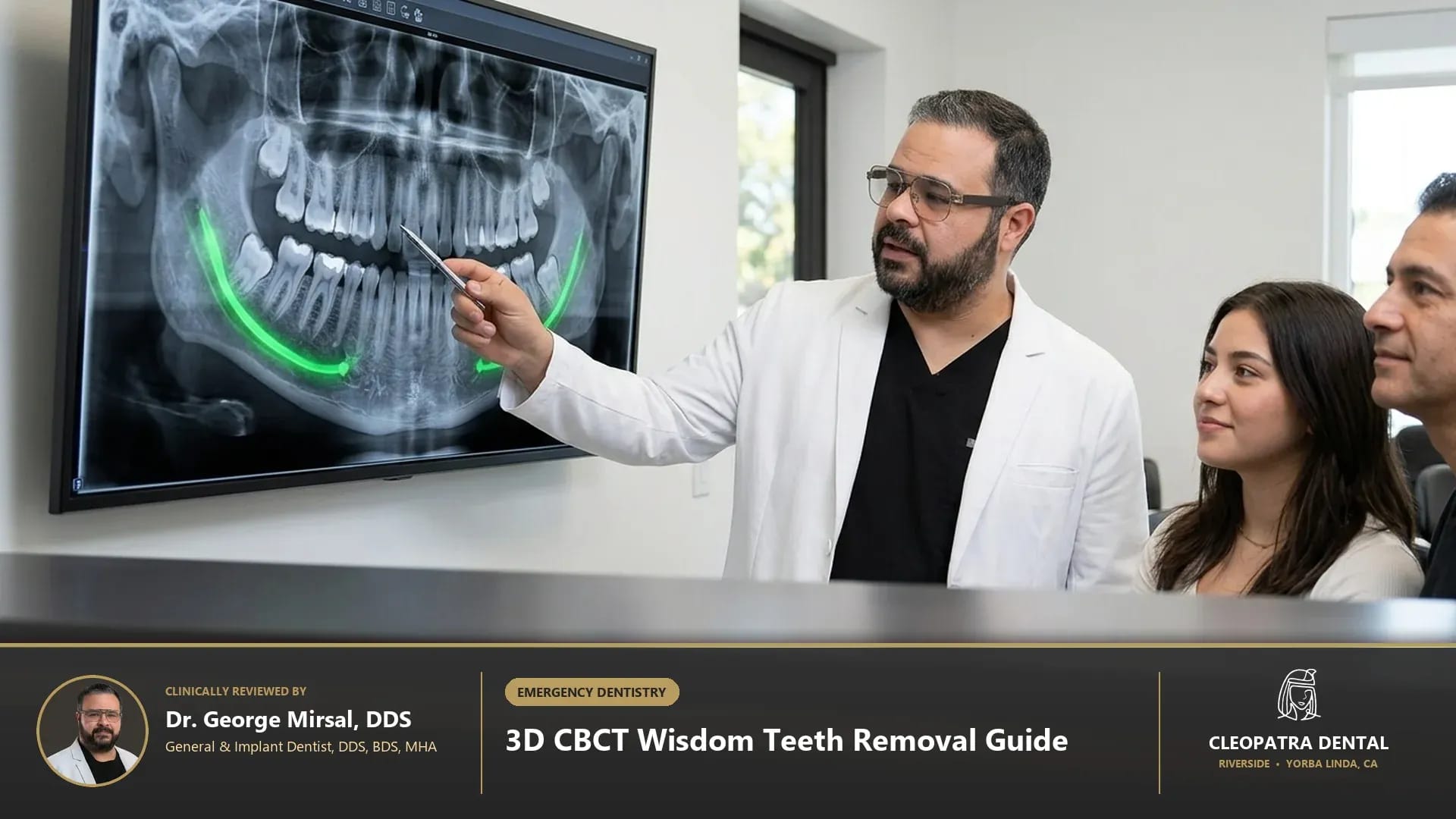
Traditional two-dimensional panoramic X-rays compress 3D craniofacial structures, creating misleading visual overlap between wisdom tooth roots and the Inferior Alveolar Nerve (IAN) canal. At Cleopatra Dental, we utilize high-definition 3D cone-beam computed tomography (CBCT, CDT D0367) to evaluate nerve proximity with sub-millimeter precision. Cross-sectional slices reveal whether the nerve runs buccal, lingual, or directly between the tooth roots, dramatically reducing the risk of temporary or permanent lip paresthesia. For acute third-molar swelling over the weekend, book same-day Saturday emergency dental relief. For acute third-molar swelling over the weekend, book same-day Saturday emergency dental relief.
Clinical Impaction Matrix: Surgical Complexity and Nerve Proximity
Comparing impaction types clarifies surgical timelines, instrumentation, and recovery expectations.
| Impaction Classification | Clinical Description & Anatomical State | Surgical Complexity & Technique | Typical Recovery Timeframe |
|---|---|---|---|
| Erupted Third Molar (D7140) | Fully erupted; normal vertical alignment | Simple extraction with surgical elevator and forceps | 2 to 3 Days; minimal swelling |
| Soft Tissue Impaction (D7220) | Penetrated bone; covered by fibrous gum flap | Conservative soft tissue incision; suture closure | 3 to 4 Days; mild soreness |
| Partial Bony Impaction (D7230) | Crown partially encased in alveolar bone | Bone troughing with piezosurgery; tooth sectioning | 4 to 5 Days; moderate swelling |
| Complete Bony Impaction (D7240) | Entirely submerged in bone; angular/horizontal | Surgical ostectomy and micro-sectioning under IV sedation | 5 to 7 Days; peaked swelling day 3 |
Full Surgical Extraction vs. Coronectomy for High-Risk Roots
When 3D CBCT imaging demonstrates that lower wisdom tooth roots are wrapped intimately around the Inferior Alveolar Nerve canal, a complete surgical extraction poses increased risk of nerve injury. In these specialized scenarios, our surgical team may perform a coronectomy (intentional partial odontectomy). The surgeon cleanly transects and removes only the enamel crown of the tooth, leaving the root fragments untouched and submerged safely beneath the bone crest. The bone naturally heals over the roots, completely eliminating pericoronitis and decay risks while ensuring 100% nerve protection.
Platelet-Rich Fibrin (PRF) for Accelerated Socket Regeneration
To accelerate surgical healing, our surgical team frequently places autologous Platelet-Rich Fibrin (PRF) membranes into the extraction sockets immediately following tooth removal. Centrifuged chairside from a small sample of the patient's blood, PRF concentrates vital growth factors and white blood cells that stimulate rapid microvascular capillary formation, cut postoperative pain by over 40%, and virtually eliminate dry socket complications. Learn why operative cleaning beats home remedies in our guide to safe relief vs. antibiotic myths for pericoronitis tooth infections. Learn why operative cleaning beats home remedies in our guide to safe relief vs. antibiotic myths for pericoronitis tooth infections.
2026 Wisdom Teeth Removal Costs in Riverside & Orange County
Clear, transparent financial planning ensures peace of mind when scheduling third molar surgery.
Important Pricing Note: The prices shown in the table below are estimated ranges; to obtain accurate pricing tailored to your specific clinical needs and insurance coverage, please contact our Riverside or Yorba Linda office.
| Extraction Complexity & ADA CDT Code | Estimated Cost Range (Per Tooth) | PPO Insurance & Financing Details |
|---|---|---|
| Erupted Wisdom Tooth Extraction (D7140) | $175 – $325 | Covered at 70% to 80% under standard PPO basic surgical benefits |
| Soft Tissue Impacted Wisdom Tooth (D7220) | $275 – $475 | Covered under PPO major oral surgery benefits; CareCredit eligible |
| Partial Bony Impacted Wisdom Tooth (D7230) | $375 – $650 | Major dental benefit; in-network insurance reduces out-of-pocket costs |
| Complete Bony Impacted Wisdom Tooth (D7240) | $475 – $850 | Major dental or medical surgery coverage; flexible monthly plans |
| IV Conscious Sedation - First 15 Mins (D9222) | $225 – $375 | Twilight sleep sedation; provides profound relaxation during surgery |
PPO Dental and Medical Insurance Benefits for Surgical Extractions
Because impacted wisdom teeth represent an active medical and orthodontic risk, many PPO dental plans and select major medical policies provide generous coverage for their surgical removal. Coverage for impacted teeth typically ranges between 50% and 80% of allowable fees. In addition, when all four third molars are removed in a single surgical session, sedation costs are consolidated, maximizing your annual dental benefit.
Financing Your Wisdom Teeth Removal with Flexible Plans
At our Riverside office and Yorba Linda clinic, we partner with CareCredit, Sunbit, and LendingClub to offer flexible 0% interest promotional payment plans for up to 12 months. This allows families to address impacted wisdom teeth before complications develop, with predictable monthly payments as low as $95 to $175 per month.
Preventing Dry Socket (Alveolar Osteitis) and Post-Surgical Complications
Dry socket is the most common post-extraction complication, occurring in approximately 2% to 5% of routine extractions and up to 15% to 20% of impacted lower molars if instructions are neglected. Understanding how to protect the healing socket ensures smooth recovery.
The Biology of the Extraction Socket Blood Clot
Following tooth extraction, nature initiates healing by forming a dark red, gelatinous blood clot inside the bony socket. This clot serves as a biological bandage, protecting exposed alveolar bone and nerve endings while fibroblasts lay down new osteoid tissue. If this clot is dislodged or chemically dissolved prematurely, air, saliva, and food particles irritate the bare bone, causing severe, throbbing pain that radiates to the ear and temple around day three or four.
Critical 72-Hour Suction Rules: Zero Straws, Smoking, or Spitting
The vast majority of dry socket cases are caused by negative intraoral pressure. For the first 72 hours post-surgery, patients must follow these non-negotiable recovery rules:
- NO Drinking Through Straws: The suction required to draw liquids through a straw creates vacuum pressure that pulls the blood clot out of the socket.
- NO Smoking or Vaping: Inhaling creates vacuum suction, while nicotine constricts microvascular capillaries and inhibits clot formation.
- NO Forceful Spitting or Rinsing: Let fluids roll gently out of your mouth into the sink. Do not swish vigorously.
- NO Carbonated or Alcoholic Beverages: Effervescence and alcohol dissolve the fibrin mesh holding the clot in place.
Managing Trismus, Swelling, and Sinus Communications
Following surgical bone removal, patients frequently experience trismus (temporary jaw muscle tightness) and facial swelling that peaks around day three. Applying an ice pack to the cheek in 20-minute intervals for the first 48 hours dramatically mitigates swelling, while transitioning to warm, moist heat on day four relaxes the masseter muscles and restores jaw opening.
The Surgical Experience and 7-Day Recovery Timeline
Third molar surgery at Cleopatra Dental is designed to be calm, comfortable, and completely pain-free from start to finish. 3D CBCT third-molar evaluations and sedation extractions are offered at our Yorba Linda oral surgery office. 3D CBCT third-molar evaluations and sedation extractions are offered at our Yorba Linda oral surgery office.
Sedation Options: IV Twilight Sedation vs. Nitrous Oxide
We offer customized anesthesia options tailored to your comfort level. With IV conscious sedation ("twilight sleep"), patients drift into deep relaxation, feeling zero pain and retaining no memory of the surgical procedure. For simpler extractions or mild anxiety, nitrous oxide ("laughing gas") combined with profound local anesthesia provides immediate calming effects that wear off within minutes of completing treatment. Inland Empire families can also schedule surgical extractions at our Riverside wisdom teeth clinic. Inland Empire families can also schedule surgical extractions at our Riverside wisdom teeth clinic.
Day-by-Day Postoperative Instructions: Ice, Diet, and Rinsing
Plan for 48 to 72 hours of restful downtime immediately after surgery. Consume a cool, soft diet—such as yogurt, applesauce, smoothies (no straws), and lukewarm broths—for the first three days. After 24 hours, begin gentle warm saltwater rinses (half a teaspoon of salt in warm water) after meals to keep the surgical sites clean without disturbing the healing clots.
Frequently Asked Questions About Wisdom Teeth Removal
At what age should wisdom teeth typically be removed?
The ideal window for wisdom tooth evaluation and extraction is between ages 16 and 22. During this period, the roots are only one-half to two-thirds formed, surrounding alveolar bone is less dense, and risk of nerve complications is lowest.
What causes dry socket after wisdom teeth extraction and how do I prevent it?
Dry socket (alveolar osteitis) occurs when the protective blood clot in the extraction socket dislodges prematurely, exposing bone and nerve endings. Prevent it by avoiding negative intraoral suction: no drinking through straws, no smoking or vaping, and no vigorous spitting for at least 72 hours.
What is a coronectomy and when is it recommended instead of full extraction?
A coronectomy (intentional partial odontectomy) is an advanced surgical technique where only the crown of an impacted mandibular wisdom tooth is removed, leaving the roots fused in bone. It is recommended when 3D CBCT reveals roots wrapped intimately around the Inferior Alveolar Nerve, preventing nerve damage.
How many days of school or work will I need to miss after surgery?
Most patients take two to three days of rest immediately following surgery. While mild swelling and jaw stiffness can persist for five to seven days, most individuals comfortably return to desk work or school by day three or four.
Verified Branch & Location: Visit Cleopatra Dental in Yorba Linda at 18651 Yorba Linda Blvd, Yorba Linda, CA 92886 (serving East Lake Village, Travis Ranch, Bryant Ranch, Kerrigan Ranch, Anaheim Hills, and Placentia near Yorba Linda Blvd and Imperial Hwy), or view directions and verified patient reviews on Google Maps directions to Cleopatra Dental Yorba Linda.
Clinically & Technically Reviewed By:
Dr. George Mirsal, DDS, BDS, MHA — General & Implant Dentist
Medical Disclaimer: This content is clinically reviewed for educational purposes in accordance with American Dental Association (ADA) and Dental Board of California guidelines and does not replace a direct in-person dental examination.