Is Ridge Augmentation Painful? Bone Grafting & Sinus Lift Guide in CA
October 22, 2026
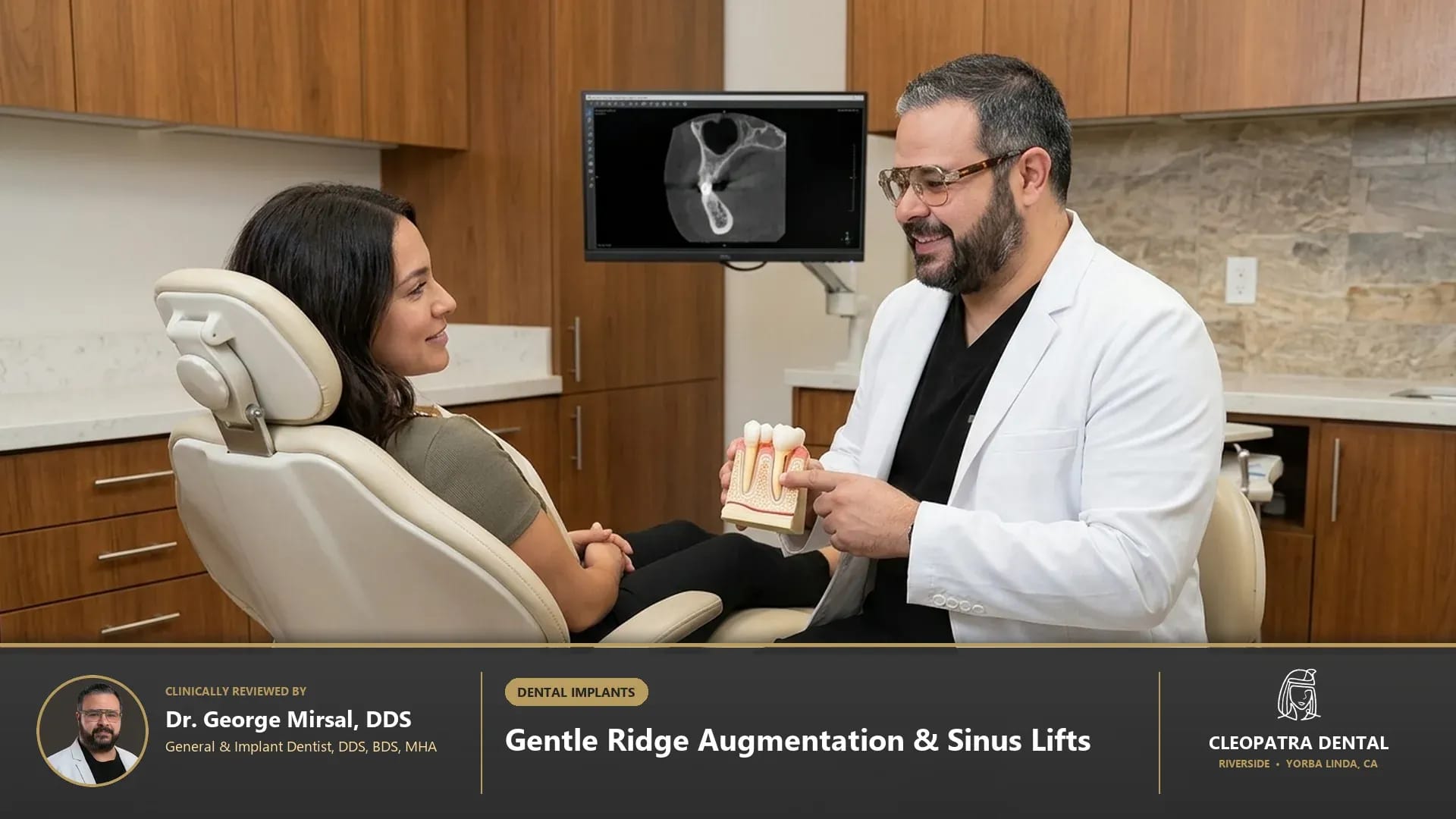
Quick Verified Summary: Ridge augmentation and pre-implant bone grafting procedures in Riverside are virtually painless during treatment thanks to advanced local anesthesia and modern sedation. Post-surgical recovery is typically mild, characterized by manageable pressure and swelling for three to five days that responds reliably to standard anti-inflammatory medications.
Demystifying Bone Grafting: Is Ridge Augmentation Actually Painful?
Fear of surgical pain is the single most common reason patients postpone necessary bone augmentation prior to dental implant placement. When teeth are lost to severe infection, trauma, or long-standing periodontal disease, the surrounding alveolar bone naturally resorbs, losing up to 40% to 60% of its horizontal width within the first year. Rebuilding this foundation through ridge augmentation is vital for supporting stable, long-lasting dental implants. Understanding what happens during surgery helps relieve anxiety and demystifies the biological healing process for Riverside patients. Rebuilding lost alveolar bone volume creates a rock-solid foundation for 3D-guided dental implant surgery. Rebuilding lost alveolar bone volume creates a rock-solid foundation for 3D-guided dental implant surgery.
Modern Anesthetic Protocols and Intraoperative Sensation
During the actual bone grafting procedure, patients experience zero pain. Modern oral surgery utilizes highly potent, lipid-soluble local anesthetics such as 4% Articaine hydrochloride with 1:100,000 epinephrine. Articaine possesses superior tissue diffusion, penetrating cortical bone plates to establish profound nerve blockade throughout the surgical field. For anxious patients, conscious oral sedation or intravenous (IV) twilight sedation provides deep relaxation, erasing procedural awareness while vital signs are continuously monitored. When damaged teeth must be removed first, our clinicians perform atraumatic tooth extraction and socket preservation to protect bone contours. When damaged teeth must be removed first, our clinicians perform atraumatic tooth extraction and socket preservation to protect bone contours.
Pain Perception vs. Pressure: What Patients Really Feel
It is clinically important to distinguish between pain and mechanical pressure. Local anesthetics block myelinated A-delta and unmyelinated C nerve fibers responsible for transmitting sharp pain signals. However, deeper mechanoreceptors that detect pressure, vibration, and saline irrigation remain mildly perceptive. Patients describe the sensation not as discomfort, but rather as mild vibrations and tactile movement similar to having a routine filling placed. Patients needing complete arch reconstruction can explore full-arch All-on-4 implant rehabilitation. Patients needing complete arch reconstruction can explore full-arch All-on-4 implant rehabilitation.
Types of Pre-Implant Bone Augmentation Procedures
Bone augmentation is not a single generic procedure; it encompasses several distinct clinical techniques matched to the severity and location of osseous deficiency.
Extraction Socket Preservation (Ridge Preservation Grafting)
The simplest and least invasive bone grafting technique is socket preservation (CDT code D7953). Performed immediately following atraumatic tooth extraction, particulate mineralized allograft or xenograft bone material is gently packed into the vacant socket. A collagen plug or resorbable barrier membrane is secured with micro-sutures over the crest. This minimally invasive procedure prevents collapse of the buccal bone plate and involves minimal post-operative discomfort. Compare multi-implant biomechanics in our 2026 All-on-X dental implant cost and procedure guide. Compare multi-implant biomechanics in our 2026 All-on-X dental implant cost and procedure guide.
Horizontal and Vertical Ridge Augmentation
When teeth have been missing for years, the alveolar ridge often atrophies into a knife-edge shape. Horizontal ridge augmentation expands the width of the bone, while vertical augmentation restores lost height. The surgeon reflects a delicate mucoperiosteal flap, secures bone particulate reinforced with titanium mesh or a bioresorbable collagen membrane, and closes the tissue tension-free. Because this requires flap mobilization, postoperative swelling is more noticeable than simple socket preservation, peaking around day three.
Maxillary Sinus Floor Elevations: Lateral Window vs. Crestal Osteotome
In the upper posterior jaw, the maxillary sinus frequently expands downward after molar loss. When less than 4 to 5 millimeters of vertical native bone remains, a lateral window sinus lift (CDT code D7951) is performed. The surgeon creates a small bony window in the lateral sinus wall, carefully reflects Schneider's membrane without perforation, and places bone graft material beneath it. When 6 to 8 millimeters of native bone remains, a less invasive crestal approach (CDT code D7952) elevates the membrane through the implant osteotomy, causing virtually zero external swelling. For related oral surgery recovery protocols, consult our complete guide to surgical wisdom teeth extraction. For related oral surgery recovery protocols, consult our complete guide to surgical wisdom teeth extraction.
Clinical Procedural Comparison: Invasiveness and Healing Horizons
Comparing pre-implant grafting techniques clarifies surgical expectations and biological healing timelines.
| Augmentation Procedure | Surgical Invasiveness Level | Typical Post-Op Soreness | Osseous Healing Horizon |
|---|---|---|---|
| Socket Preservation (D7953) | Minimally Invasive (Localized) | 1 to 2 Days; mild soreness | 3 to 4 Months before implant |
| Crestal Sinus Elevation (D7952) | Low to Moderate (Flapless/Tapped) | 2 to 3 Days; minor congestion | 4 to 5 Months (often simultaneous) |
| Lateral Window Sinus Lift (D7951) | Moderate (Direct Lateral Flap) | 3 to 5 Days; localized swelling | 6 to 9 Months before implant load |
| Vertical Ridge Augmentation | Advanced (Extensive Flap Release) | 4 to 7 Days; moderate swelling/bruising | 6 to 9 Months before implant load |
Biomaterial Selection: Autografts, Allografts, and Xenografts
Modern bone grafting relies primarily on freeze-dried mineralized human allografts (donated human bone processed to rigid safety standards) or deproteinized bovine xenografts. These osteoconductive scaffolds provide an inorganic matrix that guides native osteoblasts. Because bone materials are sterilely bottled, patients do not undergo painful donor site surgeries (autografts) from their own hip or chin, eliminating significant post-operative morbidity. To learn how soft-tissue volume is restored around recessions, read our comparison of pinhole gum rejuvenation vs. connective tissue grafting. To learn how soft-tissue volume is restored around recessions, read our comparison of pinhole gum rejuvenation vs. connective tissue grafting.
Platelet-Rich Fibrin (PRF) and Accelerated Soft-Tissue Recovery
At our Riverside dental clinic, clinicians frequently integrate autologous Platelet-Rich Fibrin (PRF) into bone grafting procedures. By centrifuging a small sample of the patient's own blood at chairside, we isolate a concentrated fibrin matrix dense with platelets, leukocytes, and vascular endothelial growth factors (VEGF). Blending PRF with bone particulates accelerates angiogenesis, reduces postoperative inflammation, and cuts tissue healing time significantly.
2026 Bone Augmentation and Sinus Lift Costs in Riverside, CA
Financial clarity is essential when planning dental implant therapy. Below are transparent 2026 estimated cost ranges for bone regeneration across the Inland Empire.
Important Pricing Note: The prices shown in the table below are estimated ranges; to obtain accurate pricing tailored to your specific clinical needs and insurance coverage, please contact our Riverside or Yorba Linda office.
| Procedure Type & ADA CDT Code | Estimated Cost Range | Dental Insurance & Payment Plans |
|---|---|---|
| Socket Preservation Graft (D7953 - per socket) | $450 – $900 | Often covered partially under PPO major restorative or extraction benefits |
| Crestal Approach Sinus Elevation (D7952) | $800 – $1,500 | May be partially reimbursed; eligible for 0% APR CareCredit financing |
| Lateral Window Sinus Augmentation (D7951) | $1,800 – $3,200 | Major dental benefit; long-term payment plans available up to 24 months |
| Horizontal / Vertical Ridge Augmentation (D7950) | $1,500 – $3,500 | HSA and FSA healthcare accounts fully applicable |
| Barrier Membrane Placement (D8000 / D7956) | $350 – $750 | Collagen membrane barrier essential for guided bone regeneration |
PPO Dental Insurance Reimbursement for Bone Grafting
Many dental insurance policies classify bone grafting under major oral surgery, covering 50% to 80% of allowable fees up to annual maximum limits. In cases where extractions are clinically necessary due to infection, socket preservation is frequently covered. Our experienced financial staff submits detailed clinical narratives and radiologic evidence to maximize your insurance benefits.
CareCredit and Phased Healthcare Financing
To eliminate financial barriers, Cleopatra Dental offers flexible monthly payment solutions through CareCredit, Sunbit, and LendingClub. Phasing your treatment—performing extractions and bone grafting in one calendar year and placing dental implants in the subsequent year—allows patients to utilize two annual insurance maximums, significantly reducing out-of-pocket costs.
Postoperative Recovery Timeline: What to Expect Day by Day
Knowing what to anticipate during recovery provides peace of mind and prevents unnecessary anxiety.
The First 72 Hours: Swelling Management and Ice Protocols
The primary symptom following ridge augmentation is mild to moderate swelling, which peaks around 48 to 72 hours post-surgery. Patients are instructed to apply an external ice pack in 20-minute intervals for the first two days. A mild dull ache is well controlled using alternating doses of ibuprofen (400–600 mg) and acetaminophen (500 mg). Vigorous spitting, sucking through straws, and smoking are strictly forbidden to avoid dislodging bone granules.
Days 4 to 14: Soft Tissue Closure and Suture Dissolution
By day four, facial swelling rapidly dissipates, and patients resume normal daily routines. A soft, lukewarm diet—including scrambled eggs, protein shakes, and pureed soups—protects the surgical site from masticatory pressure. Resorbable sutures typically dissolve within 7 to 14 days, or non-resorbable sutures are gently removed during a quick follow-up visit.
Months 3 to 6: Osseous Remodeling Before Implant Placement
While the gums feel fully recovered within two weeks, deep biological remodeling continues microscopic work beneath the surface. Osteoblasts replace the graft particles with dense living lamellar bone over 3 to 6 months. A follow-up low-dose 3D CBCT scan verifies bone density and height before scheduling comfortable implant placement.
Single-Tooth Implant Placement Following Ridge Augmentation
Once osseous maturation is achieved, placing an endosteal dental implant (CDT code D6010) is remarkably simple and fast. Autologous PRF preparation and guided bone regeneration are performed daily at our Riverside oral surgery office. Autologous PRF preparation and guided bone regeneration are performed daily at our Riverside oral surgery office.
Determining Optimal Bone Density for Implant Insertion
A successful dental implant requires at least 1.5 to 2.0 millimeters of healthy cortical bone surrounding every surface of the titanium fixture. Ridge augmentation ensures the implant achieves a primary insertion torque of 35 to 45 Ncm and an Implant Stability Quotient (ISQ) of 70 or higher, creating the biomechanical foundation for long-term osseointegration and a definitive custom monolithic zirconia crown or implant bridge. Patients in Orange County can also book pre-implant grafting consultations at our Yorba Linda dental clinic. Patients in Orange County can also book pre-implant grafting consultations at our Yorba Linda dental clinic.
Restoring Natural Contour and Peri-Implant Pink Aesthetics
Beyond mechanical support, bone augmentation restores the natural architectural convex contour of the gum tissue. Without adequate bone volume, the overlying gingiva recedes, creating unsightly dark shadows, elongated crowns, or exposed metal margins. A properly augmented ridge produces lifelike pink aesthetics that blend seamlessly with adjacent natural teeth.
Frequently Asked Questions About Bone Grafting Pain
Does ridge augmentation hurt during the surgical procedure?
No. The entire surgical site is completely numbed using advanced local anesthetics like 4% Articaine with epinephrine, and oral or IV sedation options are available. Patients feel slight vibrational pressure and water irrigation, but zero sharp pain during the surgery.
What is the difference between socket preservation and ridge augmentation?
Socket preservation (D7953) is a preventative graft placed immediately into an extraction socket to stop natural bone resorption. Ridge augmentation is a reconstructive procedure performed when bone has already resorbed, rebuilding horizontal width or vertical height.
How long does bone graft healing take before a dental implant can be placed?
Simple extraction socket preservation typically heals in 3 to 4 months. More extensive lateral ridge augmentations or sinus floor bone grafts require 4 to 6 months of biological osseous remodeling before placing a titanium implant fixture.
What can I do at home to minimize swelling and discomfort after bone grafting?
Apply an ice pack to the cheek in 20-minute intervals for the first 48 hours, avoid touching or disturbing the surgical site, eat a soft lukewarm diet, avoid using straws, and take prescribed or over-the-counter anti-inflammatories as directed.
Verified Branch & Location: Visit Cleopatra Dental in Riverside at 2955 Van Buren Boulevard, Ste H4, Riverside, CA 92503 (serving Arlington, La Sierra, Canyon Crest, Wood Streets, Orangecrest, and Corona near Van Buren Blvd and CA-91), or view directions and verified patient reviews on Google Maps directions to Cleopatra Dental Riverside.
Clinically & Technically Reviewed By:
Dr. George Mirsal, DDS, BDS, MHA — General & Implant Dentist
Medical Disclaimer: This content is clinically reviewed for educational purposes in accordance with American Dental Association (ADA) and Dental Board of California guidelines and does not replace a direct in-person dental examination.