Post-Dental Treatment Recovery Issues: Normal Healing vs. Red Flags
November 7, 2026
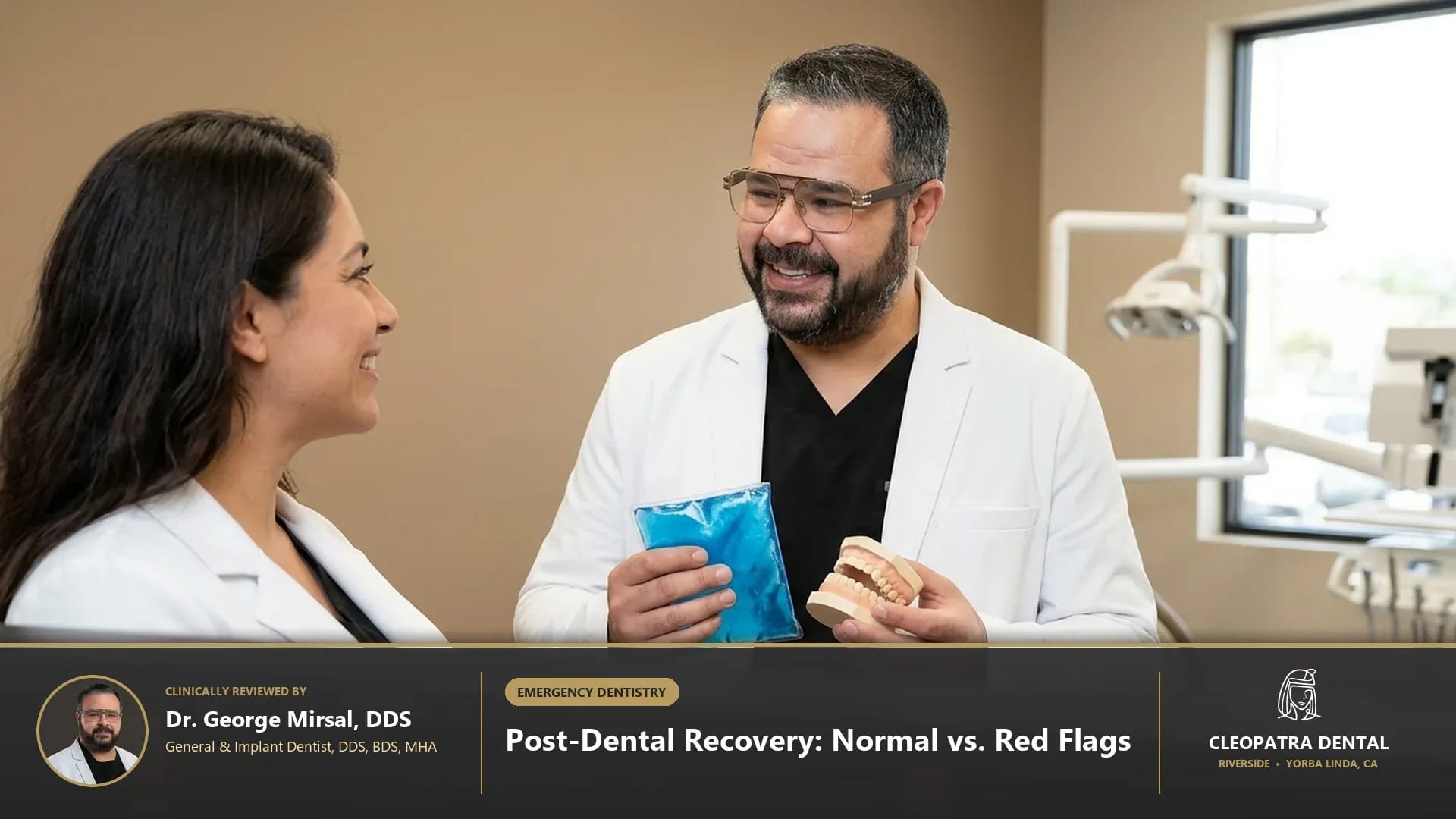
Quick Verified Summary: Most post-dental soreness, mild gum oozing, and cold sensitivity peak within 48 to 72 hours and resolve steadily over 7 to 14 days. However, worsening pain on Days 3 to 5 after extraction (dry socket, CDT D9930), a tall bite after a crown or filling (D9951), or spreading swelling requires prompt care in Riverside or Yorba Linda.
Clinical Foundations: Understanding Post-Dental Treatment Recovery Issues: Normal Healing vs. Red Flags
Patients researching post dental treatment recovery issues in Southern California deserve transparent, evidence-based guidance rooted in biological tooth preservation and long-term oral systemic health. At Cleopatra Dental, our general, restorative, and surgical clinicians evaluate every patient as a complete biomechanical system rather than treating isolated symptoms. In daily practice across Western Riverside County and North Orange County, we find that distinguishing physiological inflammatory healing (which peaks at 48 to 72 hours post-procedure and declines daily) from pathological complications—such as fibrinolytic alveolar osteitis (dry socket on Days 3 to 5), prematurities exceeding 20 to 50 microns on a new crown or composite filling (hyperocclusion), medial pterygoid trismus, or secondary fascial space infection—prevents unnecessary suffering. This diagnostic precision prevents guesswork, minimizes chairside discomfort, and establishes predictable clinical outcomes for families and older adults alike. Patients recovering from oral surgery can rely on our team for surgical tooth extraction and dry socket follow-up care.
Modern dentistry has evolved rapidly away from aggressive mechanical preparation toward minimally invasive, biologically guided care. When evaluating normal healing vs complications after dental work, our diagnostic team examines how enamel thickness, underlying dentin tubules, periodontal ligament fibers, and occlusal biting forces interact over a 10- to 20-year horizon. By integrating digital optical scanning, low-dose imaging, and biocompatible materials coded under ADA CDT standards (D9930, D9110, D0140, D9951), we tailor each treatment plan to your specific anatomy, medical history, and comfort preferences. If deep throbbing persists after a large restoration, we also provide endodontic post-treatment evaluation and pain relief.
Biological & Biomechanical Principles Behind normal healing vs complications after dental work
Every clinical decision in restorative and preventive dentistry depends on respecting microscopic tissue thresholds. Scientific studies confirm that when a new filling or crown sits even 30 microns too high while the patient is numb during placement, every chewing cycle hammers the periodontal ligament (PDL), triggering sterile apical periodontitis and cold hypersensitivity until a 5-minute selective occlusal equilibration (CDT D9951) restores even contact. When these quantitative parameters are carefully controlled at the chairside, natural dental tissues and prosthetic restorations withstand daily mastication forces—which routinely reach 70 to 150 pounds per square inch during normal chewing and exceed 250 pounds per square inch during nocturnal clenching—without premature wear, sensitivity, or structural fatigue. For third-molar-specific swelling and diet timelines, review our complete guide to wisdom teeth removal and recovery.
Advanced Biomaterials and Digital Diagnostic Standards
Material science plays an equally decisive role in clinical longevity and biocompatibility. In our clinical protocols, we utilize eugenol and guaiacol sedative alveolar dressings (CDT D9930), resorbable Gelfoam®/collagen hemostatic sponges, tannic-acid tea bag compression for capillary oozing, and 8-micron articulating foil for micro-occlusal calibration. Unlike legacy dental materials that relied on mechanical wedging or high-expansion metals, contemporary ceramic, polymer, and biologic systems bond adhesively or integrate directly with host tissues. This seals out cariogenic oral bacteria, maintains neutral salivary pH balance, and delivers natural optical translucency that blends seamlessly with your surrounding smile. Patients healing from fixture placement can track their milestones in our week-by-week dental implant recovery timeline.
Side-by-Side Clinical Comparison & Candidacy Matrix
Choosing the right clinical pathway requires comparing treatment modalities across biological conservation, expected service life, patient comfort, and maintenance requirements. During your consultation, our doctors review high-resolution intraoral photographs with you on a chairside monitor so you can see exactly what we see. The clinical comparison matrix below summarizes how each diagnostic and therapeutic option performs in real-world practice. Learn how our clinicians resolve unexpected flare-ups at the chairside in how emergency dentistry relieves acute post-op tooth pain.
| Procedure Performed | Normal Expected Recovery (Days 1 – 7) | True Complication Warning Sign | Clinical Fix at Cleopatra Dental |
|---|---|---|---|
| Tooth Extraction (D7140 / D7210) | Mild oozing Day 1; swelling peaks at 48–72 hours then improves daily | Throbbing pain starting Day 3–5 radiating to ear + foul taste (Dry Socket) | Gentle socket irrigation + soothing eugenol medicated dressing (CDT D9930) |
| New Crown or Composite Filling (D2740 / D2392) | Mild cold sensitivity for 1–2 weeks; gumline tenderness for 48 hours | Tooth feels "tall" when biting; sharp pain on chewing or lingering heat pain | 5-minute micro-occlusal bite adjustment (D9951) or sedative pulp evaluation |
| Root Canal Therapy (D3310 – D3330) | Dull ache when pressing on tooth for 3–5 days as ligament heals | Visible gum boil (parulis), progressive facial swelling, or severe unremitting pain | Intracanal medication revision, occlusal relief, or targeted antibiotic therapy |
| Scaling & Root Planing Deep Cleaning (D4341) | Temporary root sensitivity to cold liquids and slight gum soreness for 3 days | Localized periodontal abscess swelling from a dislodged subgingival tartar spicule | Localized ultrasonic pocket irrigation and 5% sodium fluoride desensitizing varnish |
How We Customize Candidacy for Complex Medical Histories
No two mouths age or heal identically. Patients managing systemic conditions such as Type 2 diabetes, hypertension, autoimmune disorders, osteoporosis, or medication-induced dry mouth (xerostomia) require customized dental protocols. Before initiating treatment related to dry socket vs normal extraction pain, we review your current medications, allergies, and systemic health markers. Adjusting local anesthetic buffering, selecting hypoallergenic metal-free ceramics, and reinforcing salivary mineral buffering ensures safe, predictable healing for every age group. See how proactive anti-inflammatory planning prevents flare-ups in how pre-operative preparation minimizes root canal recovery soreness.
Preventing Common Complications and Premature Failure
Even the finest dental restoration or preventive regimen requires protection against mechanical overload and bacterial biofilm accumulation. In clinical audits, the two leading causes of preventable dental breakdown are unaddressed nighttime teeth grinding (sleep bruxism) and interproximal plaque stagnation along the gumline. Addressing occlusal harmony early and establishing an easy-to-follow home care routine protects both your natural enamel and any restorative work for decades.
Long-Term Maintenance & Preventive Follow-Up in Southern California
Sustaining healthy clinical results over 10 to 20 years depends on partnering with a consistent dental team that monitors your gum attachment levels, bite balance, and restorative margins at every six-month checkup. At our Riverside and Yorba Linda locations, we combine ultrasonic hygiene care, digital bitewing monitoring, and occlusal nightguard checks to catch micro-changes long before they become costly emergencies.
2026 Cost Guide, ADA CDT Codes & PPO Insurance in Riverside and Yorba Linda
Financial clarity is a core pillar of patient trust at Cleopatra Dental. Treatment fees in Southern California vary according to diagnostic complexity, the number of teeth or quadrants involved, laboratory biomaterial selection, and your dental PPO insurance benefits. Before any procedure begins, our treatment coordinators verify your insurance eligibility and provide a clear, written breakdown organized by official American Dental Association Current Dental Terminology (CDT) codes.
Important Pricing Note: The prices shown in the table below are estimated ranges; to obtain accurate pricing tailored to your specific clinical needs and insurance coverage, please contact our Riverside or Yorba Linda office.
| Post-Op Follow-Up Service & ADA CDT Code | Estimated Cost & Price Range (2026) | Cleopatra Dental Patient Care Policy |
|---|---|---|
| Routine Post-Operative Suture Check / Bite Polish (In-House Patient) | $0 (Complimentary) | Included at no charge for procedures performed at Cleopatra Dental |
| Treatment of Post-Surgical Alveolar Osteitis / Dry Socket (D9930) | $0 In-House / $125 – $225 External | Immediate pain relief within 10 minutes via medicated socket dressing |
| Limited Occlusal Adjustment of High Filling or Crown (D9951) | $0 In-House / $95 – $195 External | Rebalances biting pressure to calm bruised periodontal ligament fibers |
| Problem-Focused Emergency Triage & Periapical X-Ray (D0140 / D0220) | $85 – $165 | For new patients experiencing complications from outside dental work |
Maximizing Dental PPO Insurance, HSA/FSA Funds & 0% Financing
Most PPO dental insurance plans categorize diagnostic exams, digital X-rays, and routine cleanings under preventive benefits covered at 80% to 100%, while basic and major restorative procedures receive 50% to 80% coverage up to your annual plan maximum (typically $1,500 to $2,500 per calendar year). For treatments that exceed annual insurance caps or involve elective cosmetic enhancements, patients can apply tax-free Health Savings Account (HSA) or Flexible Spending Account (FSA) dollars, or enroll in 0% APR promotional monthly financing through CareCredit, LendingClub, and Proceed Finance.
Step-by-Step Clinical Protocol & Long-Term Care Guidelines
Knowing exactly what happens before, during, and after your visit eliminates dental anxiety and empowers you to participate actively in your oral health. Our clinical workflow enforces immediate same-day office evaluation for dry socket or high bite, versus urgent hospital emergency room (911) referral if submandibular/sublingual swelling (Ludwig’s angina), fever >= 101°F, dysphagia (trouble swallowing), or dyspnea (airway restriction) develops. By breaking complex care into calm, well-paced stages, we ensure your comfort from initial check-in through long-term maintenance. Same-day post-operative bite adjustments, dry socket soothing dressings, and suture checks are performed at Cleopatra Dental in Riverside, CA.
Step 1: Comprehensive Digital Assessment and Shade/Bite Mapping
Your appointment begins with a conversation about your goals, symptoms, and past dental experiences, followed by gentle digital diagnostics. Using radiation-free iTero 3D optical scanning, intraoral high-definition cameras, and ultra-low-dose digital radiographs when indicated, we map your teeth, gums, and bite registration within minutes—eliminating messy impression trays and providing an immediate 3D visual roadmap of your mouth. North Orange County patients can also call or walk into our Yorba Linda dental clinic for immediate post-treatment triage.
Step 2: Precision Chairside Execution and Post-Care Verification
During active care, we prioritize profound comfort using topical numbing gels, pH-buffered local anesthetics, and optional nitrous oxide or oral conscious sedation. Every margin, contact point, and biting surface is verified under high magnification before you leave the chair. You also receive written post-visit care instructions and a direct follow-up call from our clinical team to confirm your recovery is progressing smoothly.
Frequently Asked Questions About Post-Dental Treatment Recovery Issues: Normal Healing vs. Red Flags
How can I tell the difference between normal extraction pain and a dry socket?
Normal extraction soreness is worst during the first 24 to 48 hours and steadily gets better each day. A dry socket (alveolar osteitis) typically strikes on Day 3 to Day 5 after extraction: pain suddenly worsens, radiates up toward your ear or temple, doesn’t respond to ibuprofen, and is accompanied by an empty-looking socket and a bad taste.
Why does my new filling or crown hurt when I chew after the numbness wears off?
When your jaw is numb during the appointment, it can be hard to feel a microscopic high spot as thin as a human hair (30 microns). Striking that high spot first on every bite bruises the shock-absorbing ligament around the root. A quick, painless 5-minute bite polish at our office resolves the soreness within 24 to 48 hours.
What should I do if my extraction site starts bleeding again at home?
First, do not spit or rinse vigorously, as that dislodges the clot. Place a dampened black tea bag (the natural tannic acid constricts blood vessels and promotes clotting) or a thick pad of sterile gauze directly over the socket and bite down with firm, continuous pressure for 30 to 45 minutes while sitting upright.
Why is my jaw stiff and hard to open after a lower molar filling or extraction?
Mild jaw stiffness (trismus) after lower dental work occurs when the medial pterygoid chewing muscle experiences temporary inflammation from keeping your mouth open or from the inferior alveolar nerve block. Starting Day 3, applying warm moist compresses for 15 minutes and doing gentle finger-stretching exercises restores full opening within 5 to 7 days.
Verified Branch & Location: Visit Cleopatra Dental in Riverside at 2955 Van Buren Boulevard, Ste H4, Riverside, CA 92503 (serving Arlington, La Sierra, Canyon Crest, Wood Streets, Orangecrest, and Corona near Van Buren Blvd and CA-91), or view directions and verified patient reviews on Cleopatra Dental Riverside post-op recovery and emergency triage clinic on Google Maps.
Clinically & Technically Reviewed By:
Dr. George Mirsal, DDS, BDS, MHA — General & Implant Dentist
Dr. Engy Halim, DDS, BDS — General & Cosmetic Dentist
Medical Disclaimer: This content is clinically reviewed for educational purposes in accordance with American Dental Association (ADA) and Dental Board of California guidelines and does not replace a direct in-person dental examination.