Permanent Dental Crowns Guide: Zirconia vs. E.max Benefits & Care
November 5, 2026
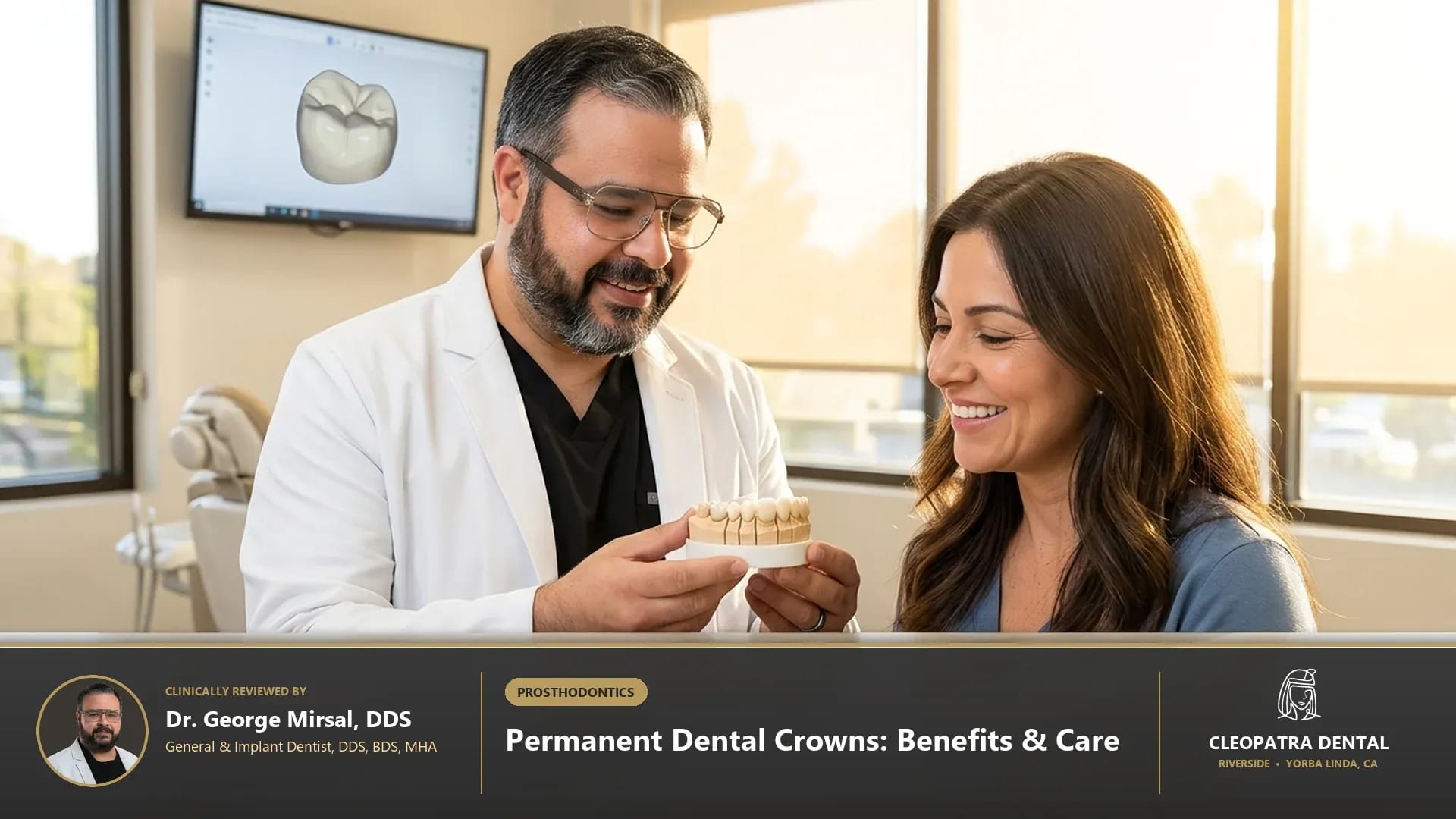
Quick Verified Summary: Permanent all-ceramic dental crowns (CDT D2740) in Riverside and Yorba Linda encase fractured, heavily filled, or root-canal-treated teeth in a 360-degree protective ferrule using 1,000 to 1,200 MPa monolithic zirconia or 450 MPa IPS e.max lithium disilicate. Digitally scanned with iTero 3D (D0470), modern crowns last 15 to 25+ years with daily margin care.
Clinical Foundations: Understanding Permanent Dental Crowns Guide: Zirconia vs. E.max Benefits & Care
Patients researching permanent dental crowns benefits and care in Southern California deserve transparent, evidence-based guidance rooted in biological tooth preservation and long-term oral systemic health. At Cleopatra Dental, our general, restorative, and surgical clinicians evaluate every patient as a complete biomechanical system rather than treating isolated symptoms. In daily practice across Western Riverside County and North Orange County, we find that once a tooth loses more than 50% of its coronal structure to decay, a wide silver amalgam filling (which expands thermally and wedges cusps apart), or endodontic root canal access, the remaining enamel walls deflect under 150-psi chewing loads—requiring a full-coverage crown (CDT D2740) with a 1.5 to 2.0 mm 360-degree vertical dentin ferrule and bonded core buildup (D2950). This diagnostic precision prevents guesswork, minimizes chairside discomfort, and establishes predictable clinical outcomes for families and older adults alike. Patients needing durable, natural-looking tooth reinforcement can explore our custom zirconia and all-porcelain dental crowns.
Modern dentistry has evolved rapidly away from aggressive mechanical preparation toward minimally invasive, biologically guided care. When evaluating zirconia vs emax vs porcelain dental crowns, our diagnostic team examines how enamel thickness, underlying dentin tubules, periodontal ligament fibers, and occlusal biting forces interact over a 10- to 20-year horizon. By integrating digital optical scanning, low-dose imaging, and biocompatible materials coded under ADA CDT standards (D2740, D2750, D2950, D9944), we tailor each treatment plan to your specific anatomy, medical history, and comfort preferences. When less than 50% of a molar cusp is damaged and a full crown isn’t required yet, we also craft conservative biomimetic porcelain inlays and onlays.
Biological & Biomechanical Principles Behind zirconia vs emax vs porcelain dental crowns
Every clinical decision in restorative and preventive dentistry depends on respecting microscopic tissue thresholds. Scientific studies confirm that monolithic yttria-stabilized tetragonal zirconia polycrystal (3Y/4Y/5Y-TZP) exhibits transformation toughening that arrests micro-crack propagation at 1,000 to 1,200 MPa flexural strength on posterior molars, while lithium disilicate (IPS e.max, 400 to 500 MPa) matches the refractive index and wear rate of natural anterior enamel. When these quantitative parameters are carefully controlled at the chairside, natural dental tissues and prosthetic restorations withstand daily mastication forces—which routinely reach 70 to 150 pounds per square inch during normal chewing and exceed 250 pounds per square inch during nocturnal clenching—without premature wear, sensitivity, or structural fatigue. While your permanent ceramic restoration is being sintered, follow our care rules on how long temporary dental crowns last and how to care for them.
Advanced Biomaterials and Digital Diagnostic Standards
Material science plays an equally decisive role in clinical longevity and biocompatibility. In our clinical protocols, we utilize multi-layered high-translucency monolithic zirconia (CDT D2740), pressed/CAD-milled IPS e.max lithium disilicate, dual-cure fiber-reinforced composite core buildups (D2950), 10-MDP zirconia primers, and resin-modified glass ionomer (RMGI) or self-adhesive dual-cure resin cements achieving < 40-micron marginal gaps. Unlike legacy dental materials that relied on mechanical wedging or high-expansion metals, contemporary ceramic, polymer, and biologic systems bond adhesively or integrate directly with host tissues. This seals out cariogenic oral bacteria, maintains neutral salivary pH balance, and delivers natural optical translucency that blends seamlessly with your surrounding smile. If an older porcelain-fused-to-metal restoration has fractured or shows a dark line, read when to repair vs. replace a chipped or broken dental crown.
Side-by-Side Clinical Comparison & Candidacy Matrix
Choosing the right clinical pathway requires comparing treatment modalities across biological conservation, expected service life, patient comfort, and maintenance requirements. During your consultation, our doctors review high-resolution intraoral photographs with you on a chairside monitor so you can see exactly what we see. The clinical comparison matrix below summarizes how each diagnostic and therapeutic option performs in real-world practice. Replacing adjacent missing teeth alongside crown work? Explore how crowns and precision attachments stabilize modern cosmetic dentures.
| Permanent Crown Material (ADA CDT) | Flexural Strength (MPa) | Aesthetics & Gumline Appearance | Best Tooth Location & Expected Lifespan |
|---|---|---|---|
| Monolithic Multi-Layer Zirconia (D2740) | 1,000 – 1,200 MPa | 100% metal-free; high strength with zero dark gumline shadow; never chips porcelain | 1st & 2nd molars, heavy grinders, and implant crowns; 15 to 25+ years |
| IPS e.max Lithium Disilicate All-Ceramic (D2740) | 400 – 500 MPa | Unmatched lifelike enamel translucency; bonds adhesively to tooth structure | Front incisors, canines, and premolars in the smile zone; 15 to 20+ years |
| Porcelain-Fused-to-High-Noble-Metal — PFM (D2750) | 85 – 120 MPa (outer porcelain layer) | Opaque core can show a dark gray metal line if gums recede over time | Legacy bridge retainers or matching existing PFM work; 10 to 15 years |
| Full Cast High-Noble Gold Alloy (D2790) | High ductility; zero fracture risk | Metallic gold color (non-tooth-colored); requires minimal 0.5 mm tooth reduction | Non-visible upper 2nd molars in extreme bruxers; 20 to 30+ years |
How We Customize Candidacy for Complex Medical Histories
No two mouths age or heal identically. Patients managing systemic conditions such as Type 2 diabetes, hypertension, autoimmune disorders, osteoporosis, or medication-induced dry mouth (xerostomia) require customized dental protocols. Before initiating treatment related to how to care for permanent dental crowns, we review your current medications, allergies, and systemic health markers. Adjusting local anesthetic buffering, selecting hypoallergenic metal-free ceramics, and reinforcing salivary mineral buffering ensures safe, predictable healing for every age group. After your final crown is cemented, review our comfort guide on how to tell normal post-crown sensitivity from a high bite.
Preventing Common Complications and Premature Failure
Even the finest dental restoration or preventive regimen requires protection against mechanical overload and bacterial biofilm accumulation. In clinical audits, the two leading causes of preventable dental breakdown are unaddressed nighttime teeth grinding (sleep bruxism) and interproximal plaque stagnation along the gumline. Addressing occlusal harmony early and establishing an easy-to-follow home care routine protects both your natural enamel and any restorative work for decades.
Long-Term Maintenance & Preventive Follow-Up in Southern California
Sustaining healthy clinical results over 10 to 20 years depends on partnering with a consistent dental team that monitors your gum attachment levels, bite balance, and restorative margins at every six-month checkup. At our Riverside and Yorba Linda locations, we combine ultrasonic hygiene care, digital bitewing monitoring, and occlusal nightguard checks to catch micro-changes long before they become costly emergencies.
2026 Cost Guide, ADA CDT Codes & PPO Insurance in Riverside and Yorba Linda
Financial clarity is a core pillar of patient trust at Cleopatra Dental. Treatment fees in Southern California vary according to diagnostic complexity, the number of teeth or quadrants involved, laboratory biomaterial selection, and your dental PPO insurance benefits. Before any procedure begins, our treatment coordinators verify your insurance eligibility and provide a clear, written breakdown organized by official American Dental Association Current Dental Terminology (CDT) codes.
Important Pricing Note: The prices shown in the table below are estimated ranges; to obtain accurate pricing tailored to your specific clinical needs and insurance coverage, please contact our Riverside or Yorba Linda office.
| Crown Restoration Service & ADA CDT Code | Estimated Cost & Price Range (2026) | Clinical Role & Dental PPO Insurance Coverage |
|---|---|---|
| All-Ceramic / Zirconia or IPS e.max Crown (D2740) | $1,150 – $1,850 per tooth | Definitive 360-degree cuspal protection; 50%–80% major PPO coverage typical |
| Core Buildup Including Any Pins When Required (D2950) | $275 – $495 | Rebuilds missing internal dentin foundation so the crown has a 2.0 mm ferrule grip |
| Prefabricated Fiber Post & Core after Root Canal (D2954) | $350 – $595 | Anchors the core buildup inside the root canal when coronal walls are severely worn |
| Digital iTero 3D Optical Crown Impression (D0470) | $0 (Included with Crown) | Replaces gag-inducing putty trays with 20-micron digital margin precision |
Maximizing Dental PPO Insurance, HSA/FSA Funds & 0% Financing
Most PPO dental insurance plans categorize diagnostic exams, digital X-rays, and routine cleanings under preventive benefits covered at 80% to 100%, while basic and major restorative procedures receive 50% to 80% coverage up to your annual plan maximum (typically $1,500 to $2,500 per calendar year). For treatments that exceed annual insurance caps or involve elective cosmetic enhancements, patients can apply tax-free Health Savings Account (HSA) or Flexible Spending Account (FSA) dollars, or enroll in 0% APR promotional monthly financing through CareCredit, LendingClub, and Proceed Finance.
Step-by-Step Clinical Protocol & Long-Term Care Guidelines
Knowing exactly what happens before, during, and after your visit eliminates dental anxiety and empowers you to participate actively in your oral health. Our clinical workflow enforces replacing legacy Porcelain-Fused-to-Metal (PFM, D2750) crowns that develop opaque gray metal collar lines at the gumline, flossing daily around the crown-to-root margin (where recurrent secondary caries can still form on natural root dentin), and wearing an occlusal nightguard (D9944) if bruxism is present. By breaking complex care into calm, well-paced stages, we ensure your comfort from initial check-in through long-term maintenance. Goop-free iTero 3D digital crown scanning and microscopic margin verification are performed at Cleopatra Dental in Yorba Linda, CA.
Step 1: Comprehensive Digital Assessment and Shade/Bite Mapping
Your appointment begins with a conversation about your goals, symptoms, and past dental experiences, followed by gentle digital diagnostics. Using radiation-free iTero 3D optical scanning, intraoral high-definition cameras, and ultra-low-dose digital radiographs when indicated, we map your teeth, gums, and bite registration within minutes—eliminating messy impression trays and providing an immediate 3D visual roadmap of your mouth. Inland Empire patients receive identical monolithic zirconia and IPS e.max crown care at our Riverside restorative and prosthodontic office.
Step 2: Precision Chairside Execution and Post-Care Verification
During active care, we prioritize profound comfort using topical numbing gels, pH-buffered local anesthetics, and optional nitrous oxide or oral conscious sedation. Every margin, contact point, and biting surface is verified under high magnification before you leave the chair. You also receive written post-visit care instructions and a direct follow-up call from our clinical team to confirm your recovery is progressing smoothly.
Frequently Asked Questions About Permanent Dental Crowns Guide: Zirconia vs. E.max Benefits & Care
Can a tooth with a permanent dental crown still get a cavity?
While the zirconia or porcelain crown itself is 100% immune to decay, the natural tooth root right where the bottom edge (margin) of the crown meets your gumline can still develop a "recurrent cavity" if plaque sits there. Brushing at a 45-degree angle along the gumline, flossing daily, and using fluoride toothpaste keeps the crown margin sealed for decades.
What is the difference between a zirconia crown and an E.max porcelain crown?
Both are 100% metal-free ceramics coded under CDT D2740. Monolithic zirconia is our strongest material (1,000 to 1,200 MPa—nearly unbreakable under heavy back-molar chewing), whereas IPS e.max lithium disilicate (400 to 500 MPa) has glass-like optical translucency that makes it ideal for visible front teeth and premolars.
Why is there a dark black or gray line at the gumline of my old dental crown?
Crowns placed 10 to 20 years ago were typically Porcelain-Fused-to-Metal (PFM, CDT D2750), which had a dark metal thimble underneath white porcelain. As gums naturally recede by a millimeter over the years, that metal edge becomes visible. Replacing it with an all-ceramic zirconia or E.max crown eliminates the dark line permanently.
How long do modern zirconia and porcelain dental crowns last?
While dental insurance plans typically allow crown replacement benefits every 5 to 7 years, clinical survival studies show that well-fitted CAD/CAM zirconia and E.max crowns routinely last 15 to 25+ years when protected with regular 6-month cleanings and a nightguard if you grind your teeth.
Verified Branch & Location: Visit Cleopatra Dental in Yorba Linda at 18651 Yorba Linda Blvd, Yorba Linda, CA 92886 (serving East Lake Village, Travis Ranch, Bryant Ranch, Kerrigan Ranch, Anaheim Hills, and Placentia near Yorba Linda Blvd and Imperial Hwy), or view directions and verified patient reviews on Cleopatra Dental Yorba Linda custom zirconia and porcelain crown clinic on Google Maps.
Clinically & Technically Reviewed By:
Dr. George Mirsal, DDS, BDS, MHA — General & Implant Dentist
Dr. Engy Halim, DDS, BDS — General & Cosmetic Dentist
Medical Disclaimer: This content is clinically reviewed for educational purposes in accordance with American Dental Association (ADA) and Dental Board of California guidelines and does not replace a direct in-person dental examination.