In-Office Teeth Whitening vs. Custom Trays in Yorba Linda & Riverside
October 23, 2026
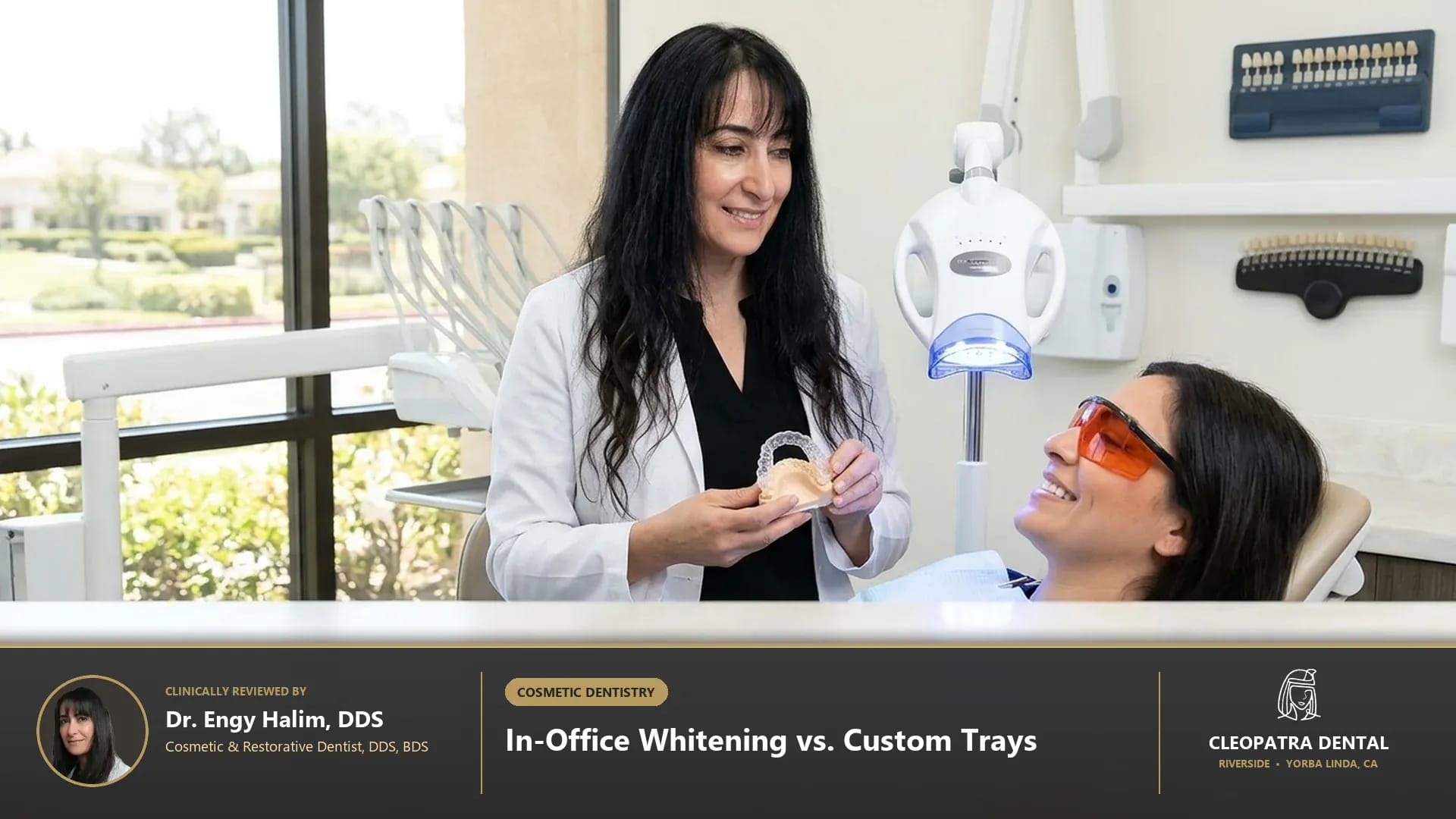
Quick Verified Summary: Professional teeth whitening in Yorba Linda and Riverside brightens discolored enamel safely under clinical supervision using high-concentration hydrogen peroxide or customized take-home carbamide peroxide trays. By breaking deep chromophore stain bonds without damaging hydroxyapatite crystal architecture, professional bleaching achieves up to eight shades of lift while advanced desensitizing protocols protect patient comfort.
The Science of Tooth Discoloration and Peroxide Bleaching Chemistry
Over time, daily consumption of coffee, tea, red wine, richly pigmented culinary spices, and natural biological aging cause enamel to lose its vibrant youthful brightness. Chromogenic organic molecules (chromophores) penetrate the semi-permeable enamel surface, lodging deeply within microscopic dentinal tubules. While commercial whitening toothpastes and over-the-counter strips offer superficial abrasive cleaning, true deep-shade lightening requires clinical chemical oxidation. At Cleopatra Dental, our general dentistry team and registered dental hygienists provide advanced professional teeth whitening treatments at our modern offices in Yorba Linda, CA and Riverside, CA. Safely lift deep intrinsic and extrinsic enamel stains with professional in-office and take-home teeth whitening. Safely lift deep intrinsic and extrinsic enamel stains with professional in-office and take-home teeth whitening.
Professional teeth whitening relies on the catalytic decomposition of hydrogen peroxide (H2O2) or carbamide peroxide (CH6N2O3). When applied to enamel, the bleaching gel releases unstable oxygen free radicals that break the conjugated double bonds of complex carbon-based chromophore molecules. By converting these dark pigments into smaller, colorless hydroxyl groups, light reflects freely off the natural hydroxyapatite crystals, restoring an authentically brilliant white smile. For severe tetracycline banding or fluorosis that resists chemical oxidation, we offer stain-resistant porcelain dental veneers. For severe tetracycline banding or fluorosis that resists chemical oxidation, we offer stain-resistant porcelain dental veneers.
Hydrogen Peroxide vs. Carbamide Peroxide: The Biochemical Breakdown
Understanding whitening protocols requires distinguishing the two active bleaching agents. Hydrogen peroxide is fast-acting, releasing its reactive oxygen species within 30 to 60 minutes, making it the ideal active agent for chairside in-office power whitening. Carbamide peroxide is a more stable compound composed of hydrogen peroxide compounded with urea in an approximate 1:3 ratio (for example, a 15% carbamide peroxide gel yields roughly 5% active hydrogen peroxide). Carbamide peroxide breaks down more slowly over two to six hours, releasing sustained oxidizing power that makes it the gold-standard choice for comfortable, overnight or extended daytime take-home custom trays. Patients combining bleaching with ceramic restorations can explore designing a complete porcelain veneer smile makeover. Patients combining bleaching with ceramic restorations can explore designing a complete porcelain veneer smile makeover.
Intrinsic vs. Extrinsic Staining: Determining Candidacy
Extrinsic stains reside on the outer surface of enamel, primarily caused by dietary tannins, polyphenols, and tobacco smoke; these respond rapidly and dramatically to peroxide bleaching. Conversely, intrinsic stains originate from within the tooth structure, frequently stemming from developmental fluorosis, childhood tetracycline antibiotic exposure, or pulpal necrosis following dental trauma. While mild intrinsic discoloration responds favorably to extended custom tray protocols, severe grey-banded tetracycline stains may require cosmetic masking through minimal-prep porcelain veneers to achieve uniform, lifelike aesthetics.
In-Office Power Whitening: Maximum Results in a Single Visit
For patients preparing for an upcoming wedding, graduation, media appearance, or professional engagement, in-office power whitening delivers immediate, clinically verified transformation in approximately one hour.
The Clinical Gingival Barrier Isolation Protocol
The primary advantage of in-office whitening is the use of high-potency professional gels containing 25% to 40% hydrogen peroxide. Because concentrations of this strength can cause transient chemical burns or ulcerations if allowed to contact delicate gingival tissues, meticulous clinical isolation is paramount. Our registered dental hygienists apply a specialized light-cured resin liquid dam along the entire gingival margin, creating an impervious physical seal that shields the gums, lips, and oral mucosa before any whitening gel is introduced. To prevent chromogen rebound during the first 48 hours, review what foods and dark beverages to avoid after fluoride and enamel care. To prevent chromogen rebound during the first 48 hours, review what foods and dark beverages to avoid after fluoride and enamel care.
Three-Stage 15-Minute Treatment Cycles
The chairside treatment proceeds through three to four consecutive 15-minute cycles. During each cycle, fresh, clinically activated bleaching gel is carefully applied to the labial surfaces of the visible upper and lower teeth. Specialized LED light spectrums may be utilized to accelerate the photo-oxidation rate. At the end of each cycle, the depleted gel is suctioned off, and fresh formulation is applied. In just 60 minutes of active chairside care, patients routinely achieve between five and eight measurable shades of improvement on the VITA Classical shade guide.
Custom Take-Home Whitening Trays: Precision and Convenience
For individuals seeking gradual, self-directed shade control or those prone to transient tooth sensitivity, custom take-home whitening trays represent an exceptionally versatile and cost-effective clinical alternative.
Custom-Milled Laboratory Trays vs. Generic Drugstore Kits
Over-the-counter whitening kits rely on generic, boil-and-bite trays or flexible plastic strips that fit poorly against the unique scalloped anatomy of your dental arch. This loose fit leads to two severe clinical shortcomings: saliva quickly enters the tray and dilutes the active peroxide, while excess gel leaks onto sensitive gingival tissues, triggering chemical irritation. At Cleopatra Dental, we capture high-definition 3D optical scans of your dentition to vacuum-form precision scalloped trays with built-in internal reservoirs. These custom reservoirs keep active carbamide peroxide gel held firmly against enamel surfaces while sealing out saliva and protecting the gumline. For a deeper look at chromophore chemistry, read our clinical article on understanding intrinsic vs. extrinsic tooth discoloration. For a deeper look at chromophore chemistry, read our clinical article on understanding intrinsic vs. extrinsic tooth discoloration.
Daywear vs. Overnight Regimens
Custom tray regimens offer flexible scheduling tailored to your lifestyle. Formulations utilizing 10% to 16% carbamide peroxide can be worn comfortably while sleeping, providing gradual oxidation over six to eight hours. Alternatively, higher-concentration 22% carbamide peroxide or daytime hydrogen peroxide formulations can be worn for just 30 to 60 minutes once daily. Most patients attain their optimal shade within 10 to 14 days of consistent application.
Clinical Comparison: In-Office Boost vs. Custom Trays vs. OTC Strips
Evaluating whitening alternatives requires comparing active chemical concentrations, clinical supervision, safety measures, and long-term touch-up convenience.
| Whitening Modality | In-Office Professional Boost | Custom Take-Home Trays | Over-the-Counter Strips |
|---|---|---|---|
| Active Peroxide Concentration | 25% – 40% Hydrogen Peroxide | 10% – 22% Carbamide Peroxide | 3% – 10% Hydrogen Peroxide |
| Time to Full Results | 60 to 90 minutes (1 appointment) | 10 to 14 consecutive days | 14 to 30 days of daily use |
| Gingival Protection Method | Light-cured resin liquid dam isolation | Custom scalloped tray margin reservoir | None (gel contacts gums freely) |
| Average Shade Improvement | 5 to 8 VITA shades | 5 to 7 VITA shades | 2 to 4 VITA shades |
| Touch-Up Convenience | Requires in-office follow-up visit | Reusable trays; purchase gel refills | Requires purchasing entire new box |
Sensitivity Management and Tubule Occlusion Protocols
Transient dentin hypersensitivity is the most common side effect of dental bleaching, occurring when peroxide ions penetrate enamel and irritate the underlying sensory nerve fibers in the dental pulp. To ensure patient comfort, Cleopatra Dental incorporates clinical desensitizing medicaments containing potassium nitrate and amorphous calcium phosphate (ACP) under CDT code D9910. Potassium nitrate depolarizes nerve membranes, preventing pain signal transmission, while ACP remineralizes enamel prisms and occludes open dentinal tubules.
The Critical Limitation: Restorations Do Not Bleach
Every patient must understand that peroxide bleaching agents have zero chemical effect on inorganic restorative materials, including composite resin fillings, porcelain inlays, veneers, or ceramic crowns. If you possess older visible front restorations, whitening will brighten your surrounding natural enamel while leaving existing restorations their original shade. To achieve an aesthetically harmonious outcome, our cosmetic clinicians recommend completing teeth whitening first, waiting two weeks for shade stabilization and oxygen dissipation, and subsequently replacing visible restorations to match your brighter smile.
2026 Teeth Whitening Cost Guide in Yorba Linda and Riverside
Professional teeth whitening represents one of the most accessible and high-impact cosmetic dental investments available. Pricing varies depending on whether you choose chairside power whitening, custom take-home trays, or our combined hybrid protocol.
Important Pricing Note: The prices shown in the table below are estimated ranges; to obtain accurate pricing tailored to your specific clinical needs and insurance coverage, please contact our Riverside or Yorba Linda office.
| Whitening Treatment & ADA CDT Code | Estimated Cost Range | Coverage & Payment Guidelines |
|---|---|---|
| In-Office Bleaching - Per Arch (D9972 x 2) | $450 – $750 | Elective cosmetic; HSA and FSA eligible expense |
| Custom Take-Home Trays - Per Arch (D9975 x 2) | $300 – $550 | Includes custom upper/lower trays and supply of gel syringes |
| Combination Hybrid Package (In-Office + Trays) | $650 – $950 | Includes chairside boost session plus custom trays for lifelong maintenance |
| Application of Desensitizing Medicament (D9910) | $45 – $95 | Often included complimentary; covered under select dental insurance |
| Syringe Refill Kit (Carbamide Peroxide 4-Pack) | $60 – $110 | Available for ongoing semi-annual maintenance touch-ups |
Insurance Clarification and Flexible Payment Options
Because teeth whitening is universally designated as an elective cosmetic procedure, private dental PPO plans and government insurance do not reimburse bleaching treatments. However, many flexible spending accounts (FSA) and health savings accounts (HSA) permit pre-tax payment for professionally administered whitening services. Additionally, Cleopatra Dental offers 0% interest promotional financing through CareCredit, enabling you to split your treatment into manageable monthly payments.
The 48-Hour "White Diet" and Prolonging Your Results
The immediate post-bleaching phase is vital for securing lasting results. During the initial 48 hours following peroxide treatment, the enamel surface pellicle is temporarily stripped, leaving microscopic enamel pores exceptionally receptive to staining pigments. Opalescence Boost chairside whitening and custom scalloped trays are provided at our Yorba Linda cosmetic dental office. Opalescence Boost chairside whitening and custom scalloped trays are provided at our Yorba Linda cosmetic dental office.
Recommended Foods During the White Diet Window
Adhere strictly to the "White Diet" for the first 48 hours. Enjoy skinless chicken breast, white fish, turkey, egg whites, white rice, pasta with light garlic and olive oil, cauliflower, peeled potatoes, water, and skim milk. Avoid anything that would leave a visible stain on a white cotton shirt—including coffee, black tea, dark colas, red wine, marinara sauce, soy sauce, mustard, ketchup, berries, and dark chocolate. Patients in Western Riverside County can also book desensitized whitening sessions at our Riverside dental studio. Patients in Western Riverside County can also book desensitized whitening sessions at our Riverside dental studio.
Long-Term Maintenance and Semi-Annual Touch-Ups
With conscientious oral care, professional whitening results typically endure between one and three years. Patients who retain their custom take-home trays can preserve optimal brightness indefinitely by performing a one-to-two-night touch-up regimen every six months following their routine dental hygiene cleaning at our Yorba Linda or Riverside clinic.
Frequently Asked Questions About Professional Teeth Whitening
How many shades whiter can I expect my teeth to get?
Most clinical patients achieve between five and eight shades of measurable improvement on the standardized VITA Classical shade guide following a 60-minute in-office whitening session. Take-home custom trays typically achieve equivalent dramatic results over ten to fourteen consecutive days of daily wear.
Will professional teeth whitening damage my tooth enamel?
No. Professional dental whitening formulas are pH-neutral and thoroughly studied by the American Dental Association (ADA). The oxidation reaction selectively dissolves organic stain molecules trapped inside microscopic enamel pores without altering the mineral density or hardness of your natural hydroxyapatite structure.
Can teeth whitening lighten existing crowns, veneers, or white fillings?
No. Peroxide whitening gels are effective only on natural tooth enamel and dentin. Inorganic dental restorations—such as porcelain crowns, composite bonding, and ceramic veneers—will not change color. If you plan to replace older visible front restorations, we recommend whitening your natural teeth first, waiting two weeks for shade stabilization, and then matching new restorations to your brightened smile.
How can I prevent tooth sensitivity after whitening?
At Cleopatra Dental, our hygiene and clinical team applies professional desensitizing medicaments containing potassium nitrate and amorphous calcium phosphate (ACP) immediately following treatment. Patients prone to sensitivity are advised to use potassium nitrate toothpaste for two weeks prior to whitening and avoid ice-cold or piping-hot beverages for 48 hours post-procedure.
Verified Branch & Location: Visit Cleopatra Dental in Yorba Linda at 18651 Yorba Linda Blvd, Yorba Linda, CA 92886 (serving East Lake Village, Travis Ranch, Bryant Ranch, Kerrigan Ranch, Anaheim Hills, and Placentia near Yorba Linda Blvd and Imperial Hwy), or view directions and verified patient reviews on verified Yorba Linda Google Business Profile on Google Maps.
Clinically & Technically Reviewed By:
Dr. Engy Halim, DDS, BDS — General & Cosmetic Dentist (Supervising Clinician)
JoAnne Schram, RDH, BVoc, MEA — Registered Dental Hygienist
Medical Disclaimer: This content is clinically reviewed for educational purposes in accordance with American Dental Association (ADA) and Dental Board of California guidelines (CA B&P § 1907–1926) and does not replace a direct in-person dental examination.