Porcelain Inlays & Onlays in Yorba Linda & Riverside: Biomimetic Guide
October 20, 2026
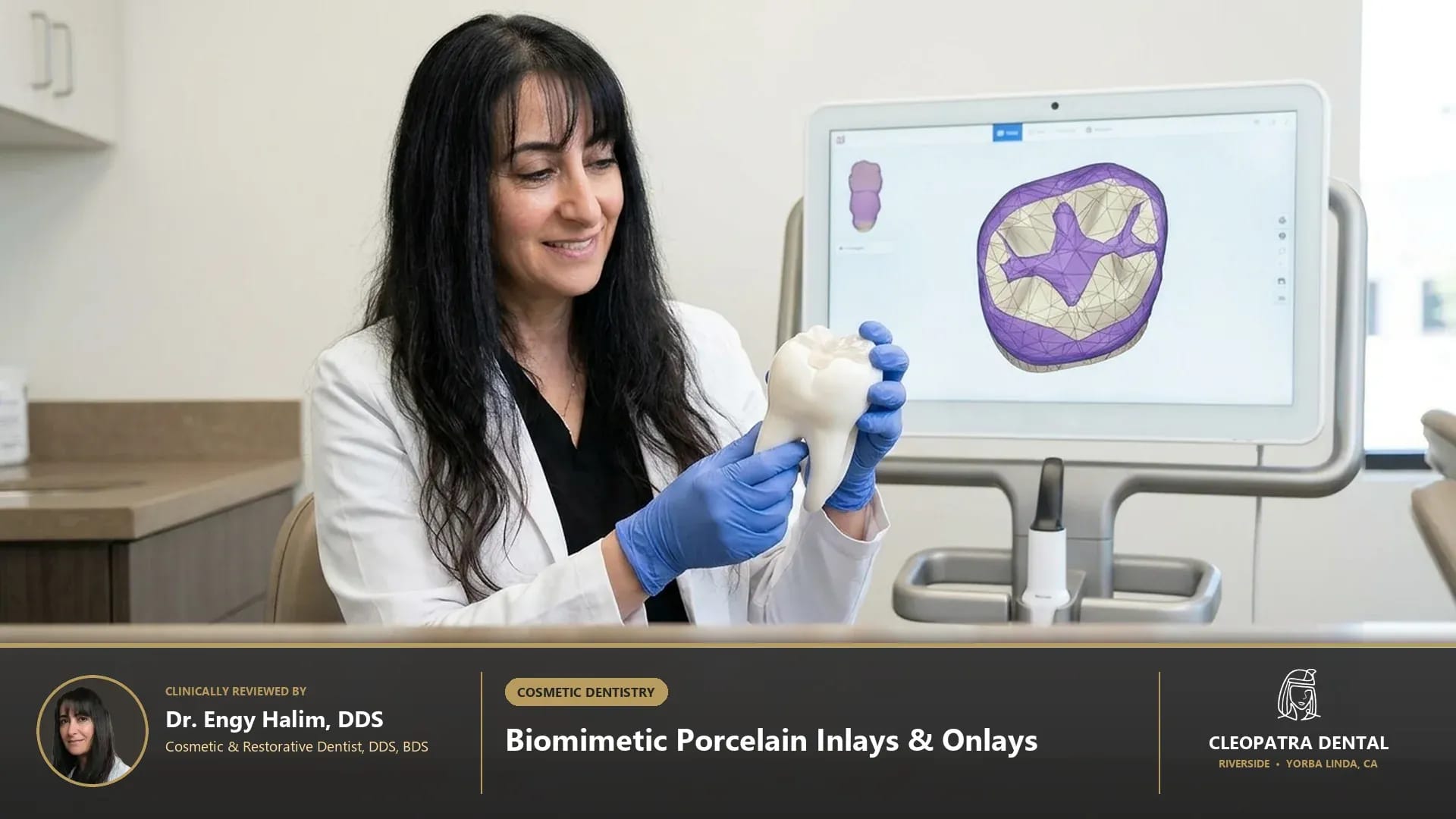
Quick Verified Summary: Biomimetic porcelain inlays and onlays in Yorba Linda and Riverside restore moderately decayed, cracked, or structurally compromised posterior teeth without requiring aggressive full-crown reduction. By adhesively bonding custom-milled IPS e.max ceramic to preserved natural enamel, these supragingival restorations protect pulp vitality, prevent fracture propagation, and deliver fifteen to twenty years of biological durability.
Understanding Biomimetic Dentistry and Conservative Tooth Restoration
In contemporary restorative dentistry, preserving living tooth structure is the paramount biological objective. For decades, molars presenting with extensive recurrent decay or cracked cusps were routinely prepared for full-coverage crowns—a process demanding the irreversible grinding down of 60% to 75% of coronal enamel and dentin. Today, advanced adhesive biomaterials enable a far more conservative, tissue-preserving approach known as biomimetic dentistry. At Cleopatra Dental, our general dental practitioners specialize in conservative porcelain inlays and onlays designed to reconstruct broken teeth while safeguarding tooth vitality at our practice in Yorba Linda, CA and our comprehensive center in Riverside, CA. Preserve up to 70% more healthy enamel and pericervical dentin with biomimetic porcelain inlays and onlays. Preserve up to 70% more healthy enamel and pericervical dentin with biomimetic porcelain inlays and onlays.
Biomimetic restorative dentistry mimics the natural biomechanics, thermal expansion, and modulus of elasticity of human teeth. Rather than relying on mechanical friction and retentive crown preparations, inlays and onlays bond directly to healthy enamel and dentin via advanced resin adhesive protocols, creating a monobloc restoration that distributes chewing forces evenly across the remaining dental arch. When circumferential ferrule support is required for deeply fractured teeth, we also fabricate full-coverage dental crown restorations. When circumferential ferrule support is required for deeply fractured teeth, we also fabricate full-coverage dental crown restorations.
The Structural Hierarchy: Inlays vs. Onlays vs. Overlays
Understanding indirect restorations requires classifying their anatomical boundaries. An inlay (ADA CDT D2610) fits entirely within the central occlusal fossa between the chewing cusps, serving as a biocompatible, fracture-resistant alternative to failing amalgam or direct composite resin fillings. An onlay (CDT D2642 / D2643) is more extensive, covering one or more damaged cuspal peaks to shield fragile vertical enamel walls from split-tooth fractures. When an onlay covers all cusps of a posterior molar while still terminating above the gumline, it is clinically termed an overlay or partial crown, delivering 360-degree occlusal protection with zero subgingival tooth mutilation. For front-teeth cosmetic enhancements using ultra-thin lithium disilicate, see our guide to porcelain veneers for anterior smile makeovers. For front-teeth cosmetic enhancements using ultra-thin lithium disilicate, see our guide to porcelain veneers for anterior smile makeovers.
Biological Enamel Preservation vs. Full-Crown Tooth Amputation
The biomechanical cost of a traditional dental crown is profound. Aggressive circular preparation exposes millions of fluid-filled dentinal tubules, triggering pulpal thermal trauma and inducing chronic micro-inflammation. Long-term clinical studies indicate that between 10% and 18% of teeth prepared for full-coverage crowns eventually lose vitality, necessitating root canal therapy. Conversely, adhesively bonded porcelain onlays preserve 70% to 80% of intact natural tooth structure, keeping margins accessible and leaving the pulp chamber undisturbed in over 98% of cases.
Immediate Dentin Sealing (IDS) and Deep Margin Elevation Protocols
Achieving two decades of bond longevity requires rigorous adhesion science. At Cleopatra Dental, our restorative clinicians employ cutting-edge biomimetic protocols, including Immediate Dentin Sealing (IDS) and Deep Margin Elevation (DME), to ensure maximum bond strength and patient comfort.
The Immediate Dentin Sealing Advantage
Immediately following the removal of decay or defective old fillings, freshly cut dentin is scrubbed with chlorhexidine and sealed with a high-performance gold-standard bonding agent before taking digital impressions. This immediate application of primer and resin creates a hybrid layer uncompromised by salivary contamination or temporary cement. Research demonstrates that IDS increases microtensile bond strength by over 400%, virtually eliminates post-operative temperature sensitivity, and protects the dental pulp during laboratory fabrication. If an existing restoration chips or debonds, consult our clinical triage guide on when to repair or replace a damaged dental crown. If an existing restoration chips or debonds, consult our clinical triage guide on when to repair or replace a damaged dental crown.
Deep Margin Elevation (DME) and Periodontal Harmony
When subgingival tooth fractures or root caries extend beneath the gingival margin, traditional dentistry often required surgical crown lengthening—removing alveolar bone and soft tissue to expose tooth margins. Through Deep Margin Elevation, our clinicians isolate the cavity with specialized curved matrix bands and elevate the deep proximal margin supragingivally using highly filled flowable composite. This conservative procedure avoids traumatic bone resection, respects the biological width of gingival attachments, and facilitates a pristine optical scan for the definitive porcelain onlay.
Clinical Comparison: Inlays/Onlays vs. Crowns vs. Direct Fillings
Choosing the appropriate restoration depends on the percentage of remaining sound tooth structure, occlusal loading, and aesthetic requirements. While small lesions are easily repaired with direct fillings, teeth with compromised cusps demand indirect reinforcement.
| Clinical Parameter | Biomimetic Porcelain Onlays | Traditional Full-Coverage Crowns | Direct Composite Resin Fillings |
|---|---|---|---|
| Preserved Natural Tooth Structure | 70% to 85% of healthy enamel and dentin | 25% to 40% (60%-75% removed) | 85% to 95% (decay removal only) |
| Cuspal Fracture Protection | High; splints and distributes biting forces | Maximum circumferential protection | Low; does not reinforce weakened cusps |
| Margin Location & Gum Health | Supragingival; avoids gingival irritation | Subgingival; risks chronic inflammation | Depends on original cavity depth |
| Risk of Future Root Canal Therapy | Extremely low (< 2% over 10 years) | Moderate to high (10% to 18%) | Low unless initial decay was deep |
| Expected Service Life | 15 to 20+ years with proper hygiene | 12 to 20 years | 5 to 8 years before breakdown |
Material Science: Lithium Disilicate (IPS e.max) vs. Lab Resins
Modern inlays and onlays are precision-milled from solid blocks of lithium disilicate glass-ceramic. This material matches the coefficient of thermal expansion of human enamel, expanding and contracting synchronously with natural teeth during hot and cold temperature shifts. Direct resin restorations, by contrast, experience polymerization shrinkage and volumetric wear under heavy molar grinding. When crowns are strictly unavoidable due to extensive prior destruction, our restorative team provides modern crown and bridge restorations crafted from monolithic zirconia. Learn how to protect your provisional onlay or crown by reading our guide on caring for temporary restorations between lab visits. Learn how to protect your provisional onlay or crown by reading our guide on caring for temporary restorations between lab visits.
Front Teeth Considerations: Composite Bonding vs. Porcelain Veneers
While inlays and onlays represent conservative biomimetic solutions for chewing molars and premolars, anterior front teeth face different cosmetic and tensile demands. For minor incisal chips or localized gaps, direct composite bonding offers an economical, non-invasive repair. However, for full aesthetic rejuvenations, porcelain veneers provide unmatched stain resistance, optical translucency, and edge strength. Understanding where conservative restorations excel ensures optimal treatment selection across your entire dentition.
2026 Porcelain Inlays & Onlays Cost Guide in Yorba Linda and Riverside
Biomimetic inlays and onlays represent an investment in biological tooth preservation that pays dividends by preventing costly future root canals, build-ups, and crown replacements. The fee structure reflects master ceramist laboratory fees, CAD/CAM precision design, and meticulous clinical bonding protocols.
Important Pricing Note: The prices shown in the table below are estimated ranges; to obtain accurate pricing tailored to your specific clinical needs and insurance coverage, please contact our Riverside or Yorba Linda office.
| Restorative Procedure & ADA CDT Code | Estimated Cost Range (Per Tooth) | Dental Insurance & Financing Guidelines |
|---|---|---|
| Porcelain Inlay - One Surface (D2610) | $850 – $1,350 | Covered under PPO major benefits (50%–80% after deductible) |
| Porcelain Onlay - Two Surfaces (D2642) | $1,050 – $1,650 | Standard major restorative benefit coverage under most PPO plans |
| Porcelain Onlay - Three or More Surfaces (D2643) | $1,200 – $1,850 | Commonly approved as partial crown alternative by dental insurance |
| Full-Coverage Ceramic Crown (D2740) | $1,100 – $1,950 | Reimbursed at 50% under major restorative benefit category |
| Direct Composite Resin Filling (D2391 / D2392) | $220 – $450 | Covered under basic restorative benefits (70%–80% reimbursement) |
Insurance Verification and Maximizing Annual PPO Maximums
Unlike purely cosmetic veneers, dental inlays and onlays are classified by dental insurance providers as essential restorative care. When placed to treat decay, crack lines, or fractured cusps, dental PPO plans typically cover between 50% and 80% of the cost up to your plan's annual maximum limit. Our administrative coordinators work directly with insurance carriers to provide detailed pre-treatment authorizations, ensuring transparent out-of-pocket clarity before your procedure begins.
0% Interest Financing via CareCredit and Flexible Payment Plans
To accommodate restorative treatments without financial stress, Cleopatra Dental offers 0% APR promotional financing for up to 24 months through CareCredit, LendingClub, and Proceed Finance. These flexible plans allow you to protect your natural teeth with premium biomimetic ceramic restorations through affordable, predictable monthly payments.
Step-by-Step Clinical Procedure: What Patients Experience
Receiving a custom porcelain inlay or onlay at Cleopatra Dental involves two meticulously coordinated appointments designed for maximum comfort and long-term clinical success.
Visit 1: Conservative Debridement, Immediate Dentin Sealing & 3D Scanning
Following gentle local anesthesia, the clinician isolates the target tooth with a rubber dam. Old amalgam or composite restorations and recurrent decay are atraumatically removed using micro-air abrasion. Sound enamel walls and healthy cusps are meticulously preserved. Immediate Dentin Sealing is applied, followed by high-definition 3D intraoral digital optical scanning. A lightweight provisional restoration is fabricated to protect the prepared tooth while our partner laboratory mills your customized restoration.
Visit 2: Hydrofluoric Acid Etching, Adhesive Cementation & Occlusal Refining
Approximately one to two weeks later, the provisional is gently removed, and the tooth is isolated under a rubber dam. The internal surface of the ceramic onlay is micro-etched with 5% hydrofluoric acid and treated with a silane coupling agent. The tooth enamel is etched with 37% phosphoric acid. A warmed, dual-cure or light-cure resin cement is applied, seating the onlay under continuous positive pressure. Once excess cement is removed, the restoration is light-cured, and bite contacts are precisely refined using thin articulating foil.
Long-Term Maintenance and Protecting Your Investment
Biomimetic restorations bond so tightly that secondary decay at the margins is exceptionally rare when supported by sound oral hygiene habits. Rubber-dam isolation and Immediate Dentin Sealing (IDS) are standard protocols at our Yorba Linda biomimetic dentistry office. Rubber-dam isolation and Immediate Dentin Sealing (IDS) are standard protocols at our Yorba Linda biomimetic dentistry office.
Daily Hygiene Practices for Ceramic Restorations
Brush twice daily with a soft-bristled toothbrush and non-abrasive fluoride toothpaste, and floss daily between your teeth. Unlike crowns that sit deep beneath the gumline and accumulate plaque, inlays and onlays terminate supragingivally, making plaque removal straightforward and predictable. Inland Empire patients can also schedule adhesive ceramic onlays at our Riverside restorative dental studio. Inland Empire patients can also schedule adhesive ceramic onlays at our Riverside restorative dental studio.
Occlusal Guard Protection for Patients with Bruxism
If you clench or grind your teeth during sleep, excessive nocturnal bite forces can stress natural enamel and ceramic margins alike. Wearing a custom-milled occlusal nightguard cushions biting forces, eliminates micro-fatigue along the resin bond interface, and safeguards your restorative dental investment for decades.
Frequently Asked Questions About Porcelain Inlays and Onlays
What is the difference between a dental inlay and an onlay?
A dental inlay restores deep internal damage within the central grooves of a molar between the cusps, functioning as a high-precision lab-milled alternative to a large filling. A dental onlay (often called a partial crown) extends over one or more damaged chewing cusps, reinforcing weakened enamel walls and preventing tooth fractures under masticatory loads.
Why choose a porcelain onlay instead of a traditional full crown?
A porcelain onlay preserves between 70% and 80% of your healthy natural tooth structure, requiring only selective removal of damaged areas. Traditional full-coverage crowns require grinding away 60% to 75% of healthy tooth enamel and dentin circumferential around the tooth, which substantially increases the risk of pulpal inflammation and root canals.
How long do porcelain inlays and onlays last?
When bonded adhesively to healthy enamel using modern resin cements, high-strength IPS e.max porcelain inlays and onlays routinely last between fifteen and twenty years. Maintaining excellent oral hygiene, avoiding chewing ice or non-food objects, and wearing an occlusal nightguard if you clench or grind your teeth ensures maximum longevity.
Are dental inlays and onlays covered by insurance in California?
Yes. Most PPO dental insurance plans recognize inlays and onlays as major restorative procedures (under CDT codes D2610, D2642, and D2643), typically reimbursing between 50% and 80% of the allowable fee up to your annual policy maximum. Our coordinators in Yorba Linda and Riverside verify your benefits prior to treatment.
Verified Branch & Location: Visit Cleopatra Dental in Yorba Linda at 18651 Yorba Linda Blvd, Yorba Linda, CA 92886 (serving East Lake Village, Travis Ranch, Bryant Ranch, Kerrigan Ranch, Anaheim Hills, and Placentia near Yorba Linda Blvd and Imperial Hwy), or view directions and verified patient reviews on Cleopatra Dental Yorba Linda on Google Maps.
Clinically & Technically Reviewed By:
Dr. Engy Halim, DDS, BDS — General & Cosmetic Dentist
Dr. George Mirsal, DDS, BDS, MHA — General & Implant Dentist
Medical Disclaimer: This content is clinically reviewed for educational purposes in accordance with American Dental Association (ADA) and Dental Board of California guidelines and does not replace a direct in-person dental examination.